Ch. 8 - Integration Techniques
Briggs - Calculus: Early Transcendentals 3rd Edition
Briggs3rd EditionCalculus: Early TranscendentalsISBN: 9780136847243Non è quello che usi tu?Cambia libro di testo
Capitolo 8, Problema 8.5.94c

94. [Use of Tech] Skydiving A skydiver has a downward velocity given by v(t) = V_T [(1 - e^(-2gt/V_T))/(1 + e^(-2gt/V_T))],
where t = 0 is the instant the skydiver starts falling, g = 9.8 m/s² is the acceleration due to gravity, and V_T is the terminal velocity of the skydiver.
c. Verify by integration that the position function is given by
s(t) = V_T t + (V_T²/g) ln[(1 + e^(-2gt/V_T))/2],
where s'(t) = v(t) and s(0) = 0.

Guida verificata passo dopo passo
1
Start with the given velocity function: \(v(t) = V_T \left( \frac{1 - e^{-\frac{2gt}{V_T}}}{1 + e^{-\frac{2gt}{V_T}}} \right)\). Since velocity is the derivative of position, we have \(s'(t) = v(t)\), so to find \(s(t)\), integrate \(v(t)\) with respect to \(t\).
Rewrite the velocity function to simplify the integral. Notice that \(\frac{1 - e^{-x}}{1 + e^{-x}} = \tanh\left( \frac{x}{2} \right)\), where \(x = \frac{2gt}{V_T}\). So, \(v(t) = V_T \tanh\left( \frac{gt}{V_T} \right)\). This substitution makes the integral more straightforward.
Set up the integral for position: \(s(t) = \int v(t) \, dt = \int V_T \tanh\left( \frac{gt}{V_T} \right) dt\). Since \(V_T\) is constant, factor it out: \(s(t) = V_T \int \tanh\left( \frac{gt}{V_T} \right) dt\).
Use substitution to integrate: Let \(u = \frac{gt}{V_T}\), so \(du = \frac{g}{V_T} dt\) or \(dt = \frac{V_T}{g} du\). Rewrite the integral: \(s(t) = V_T \int \tanh(u) \cdot \frac{V_T}{g} du = \frac{V_T^2}{g} \int \tanh(u) du\).
Recall the integral of hyperbolic tangent: \(\int \tanh(u) du = \ln(\cosh(u)) + C\). Therefore, \(s(t) = \frac{V_T^2}{g} \ln(\cosh(u)) + C = \frac{V_T^2}{g} \ln\left( \cosh\left( \frac{gt}{V_T} \right) \right) + C\). Use the initial condition \(s(0) = 0\) to solve for \(C\) and express \(\cosh\) in terms of exponentials to match the given formula.

Risposta video verificata per un problema simile:

Questa soluzione video è stata consigliata dai nostri tutor come utile per risolvere questo problema.
Durata del video:
7m

Concetti chiave

Ecco i concetti essenziali che devi comprendere per rispondere correttamente alla domanda.

Relationship Between Velocity and Position via Integration

Velocity is the derivative of position with respect to time. To find the position function s(t) from a given velocity v(t), you integrate v(t) with respect to time. The constant of integration is determined using initial conditions, such as s(0) = 0 in this problem.
Video consigliato:
05:06
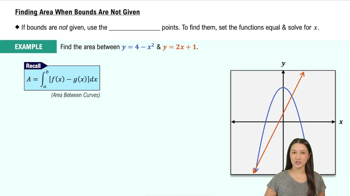
Finding Area When Bounds Are Not Given

Integration of Exponential Functions

The velocity function involves exponential terms of the form e^(-2gt/V_T). Integrating such functions requires understanding how to handle exponentials and logarithms, often using substitution methods to simplify the integral into a form involving natural logarithms.
Video consigliato:
05:11
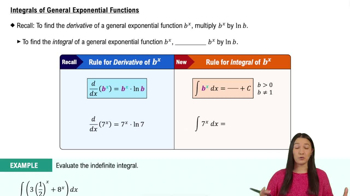
Integrals of General Exponential Functions

Initial Conditions and Determining Constants of Integration

When integrating to find position, an arbitrary constant appears. Applying the initial condition s(0) = 0 allows you to solve for this constant, ensuring the position function accurately reflects the physical scenario starting at zero displacement.
Video consigliato:
Percorso guidato
06:46
Initial Value Problems Example 1