


Ch. 8 - Integration Techniques
Briggs - Calculus: Early Transcendentals 3rd Edition
Briggs3rd EditionCalculus: Early TranscendentalsISBN: 9780136847243Non è quello che usi tu?Cambia libro di testo
Capitolo 8, Problema 8.3.75c

75. Exploring powers of sine and cosine
c. Prove that ∫₀ᵖⁱ sin²(nx) dx has the same value for all positive integers n.

Guida verificata passo dopo passo
1
Step 1: Begin by recalling the trigonometric identity for sine squared: sin²(x) = (1 - cos(2x))/2. This identity will simplify the integral.
Step 2: Substitute sin²(nx) in the integral with the identity: ∫₀ᵖⁱ sin²(nx) dx = ∫₀ᵖⁱ (1 - cos(2nx))/2 dx. Split the integral into two parts: ∫₀ᵖⁱ (1/2) dx - ∫₀ᵖⁱ (cos(2nx)/2) dx.
Step 3: Evaluate the first integral ∫₀ᵖⁱ (1/2) dx. Since this is a constant, the result is straightforward: (1/2) * x evaluated from 0 to π.
Step 4: For the second integral ∫₀ᵖⁱ (cos(2nx)/2) dx, recall that the integral of cosine over a full period (or multiples of π) is zero. Specifically, ∫₀ᵖⁱ cos(2nx) dx = 0 for any positive integer n.
Step 5: Combine the results from Step 3 and Step 4. The first integral contributes a constant value, while the second integral contributes zero. Therefore, the value of ∫₀ᵖⁱ sin²(nx) dx is independent of n and remains the same for all positive integers.

Risposta video verificata per un problema simile:

Questa soluzione video è stata consigliata dai nostri tutor come utile per risolvere questo problema.
Durata del video:
3m

Concetti chiave

Ecco i concetti essenziali che devi comprendere per rispondere correttamente alla domanda.

Definite Integrals

A definite integral calculates the accumulation of a function's values over a specific interval, providing the net area under the curve. In this case, the integral ∫₀ᵖⁱ sin²(nx) dx evaluates the area under the sine squared function from 0 to π, which is crucial for proving the equality for different values of n.
Video consigliato:
Percorso guidato
05:43
Definition of the Definite Integral

Trigonometric Identities

Trigonometric identities are equations involving trigonometric functions that hold true for all values of the variables. The identity sin²(x) = (1 - cos(2x))/2 is particularly useful in this context, as it simplifies the integral of sin²(nx) and allows for easier evaluation across different integer values of n.
Video consigliato:
7:17
Verifying Trig Equations as Identities

Periodicity of Sine Function

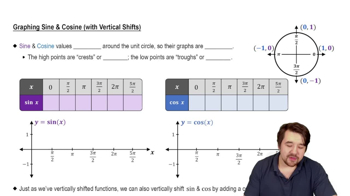
The sine function is periodic, meaning it repeats its values in regular intervals. For sin²(nx), the period is π/n, which implies that as n changes, the function still retains a consistent average value over the interval [0, π]. This periodicity is key to demonstrating that the integral yields the same result for all positive integers n.
Video consigliato:
Percorso guidato
5:53
Graph of Sine and Cosine Function
Pratica correlata
Domanda del libro di testo

82. A family of exponentials The curves y = x * e^(-a * x) are shown in the figure for a = 1, 2, and 3.

c. Find the area of the region bounded by y = x * e^(-a * x) and the x-axis on the interval [0, b]. Because this area depends on a and b, we call it A(a, b).

73
views
Domanda del libro di testo

Gaussians An important function in statistics is the Gaussian (or normal distribution, or bell-shaped curve), f(x) = e^(-ax²).

c. Complete the square to evaluate ∫ from -∞ to ∞ of e^(-(ax² + bx + c)) dx, where a > 0, b, and c are real numbers.

78
views
Domanda del libro di testo

45–48. {Use of Tech} Trapezoid Rule and Simpson’s Rule Consider the following integrals and the given values of n.

45. ∫(0 to 1) e^(2x) dx; n = 25

c. Compute the absolute errors in the Trapezoid Rule and Simpson’s Rule with 2n subintervals.

67
views
Domanda del libro di testo

3. What term(s) should appear in the partial fraction decomposition of a proper rational function with each of the following?

c. A factor of (x² + 2x + 6) in the denominator

62
views
Domanda del libro di testo

60. Two Methods

c. Verify that your answers to parts (a) and (b) are consistent.

37
views
Domanda del libro di testo

94. [Use of Tech] Skydiving A skydiver has a downward velocity given by v(t) = V_T [(1 - e^(-2gt/V_T))/(1 + e^(-2gt/V_T))],

where t = 0 is the instant the skydiver starts falling, g = 9.8 m/s² is the acceleration due to gravity, and V_T is the terminal velocity of the skydiver.

c. Verify by integration that the position function is given by

s(t) = V_T t + (V_T²/g) ln[(1 + e^(-2gt/V_T))/2],

where s'(t) = v(t) and s(0) = 0.

59
views