Ch. 8 - Integration Techniques
Briggs - Calculus: Early Transcendentals 3rd Edition
Briggs3rd EditionCalculus: Early TranscendentalsISBN: 9780136847243Non è quello che usi tu?Cambia libro di testo
Capitolo 8, Problema 8.3.25

9–61. Trigonometric integrals Evaluate the following integrals.
25. ∫ sin²x cos⁴x dx

Guida verificata passo dopo passo
1
Step 1: Recognize that the integral involves powers of sine and cosine. For integrals of this type, it is often helpful to use trigonometric identities to simplify the expression. Specifically, use the Pythagorean identity: sin²x = 1 - cos²x or cos²x = 1 - sin²x, depending on the situation.
Step 2: Split the powers of sine and cosine into manageable parts. For example, rewrite sin²x cos⁴x as sin²x (cos²x)². This will allow us to work with smaller powers and apply substitution techniques.
Step 3: Use substitution to simplify the integral. Let u = cosx, which implies du = -sinx dx. Rewrite the integral in terms of u and du. The integral becomes ∫ sin²x cos⁴x dx = ∫ (1 - u²) u⁴ (-du).
Step 4: Simplify the integral further. Distribute the terms and simplify: ∫ (1 - u²) u⁴ (-du) = -∫ (u⁴ - u⁶) du. Now, integrate each term separately using the power rule for integration: ∫ uⁿ du = uⁿ⁺¹ / (n + 1).
Step 5: After integrating, substitute back u = cosx to return the solution to the original variable x. Combine the terms and include the constant of integration C.

Risposta video verificata per un problema simile:

Questa soluzione video è stata consigliata dai nostri tutor come utile per risolvere questo problema.
Durata del video:
3m

Concetti chiave

Ecco i concetti essenziali che devi comprendere per rispondere correttamente alla domanda.

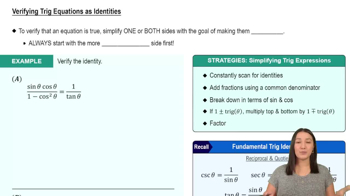
Trigonometric Identities

Trigonometric identities are equations involving trigonometric functions that are true for all values of the variables. Key identities include the Pythagorean identities, angle sum and difference identities, and double angle formulas. These identities can simplify integrals involving trigonometric functions, making it easier to evaluate them.
Video consigliato:
7:17
Verifying Trig Equations as Identities

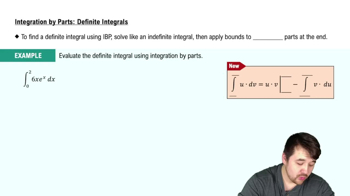
Integration Techniques

Integration techniques are methods used to find the integral of a function. Common techniques include substitution, integration by parts, and trigonometric substitution. For integrals involving products of trigonometric functions, such as sin²x and cos⁴x, using substitution or recognizing patterns can significantly simplify the process.
Video consigliato:
Percorso guidato
06:18
Integration by Parts for Definite Integrals

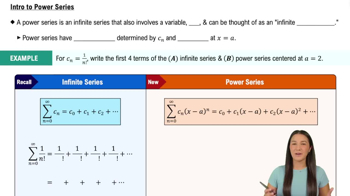
Power Reduction Formulas

Power reduction formulas are used to express higher powers of sine and cosine in terms of first powers. For example, sin²x can be rewritten using the identity sin²x = (1 - cos(2x))/2. These formulas are particularly useful in integrals, as they transform the integrand into a more manageable form, facilitating easier integration.
Video consigliato:
05:58
Intro to Power Series
Pratica correlata
Domanda del libro di testo

66-68. Areas of regions (Use of Tech) Find the area of the following regions.

66. The region bounded by the curve y = (x - x²)/[(x + 1)(x² + 1)] and the x-axis from x = 0 to x = 1

41
views

Domanda del libro di testo

9–61. Trigonometric integrals Evaluate the following integrals.

34. ∫ tan⁹x sec⁴x dx

41
views
Domanda del libro di testo

76–83. Preliminary steps The following integrals require a preliminary step such as a change of variables before using the method of partial fractions. Evaluate these integrals.

79. ∫ [sec t / (1 + sin t)] dt

41
views
Domanda del libro di testo

27. {Use of Tech} Midpoint Rule, Trapezoid Rule, and relative error

Find the Midpoint and Trapezoid Rule approximations to ∫(0 to 1) sin(πx) dx using n = 25 subintervals. Compute the relative error of each approximation.

152
views
Domanda del libro di testo

95–98. {Use of Tech} Numerical methods Use numerical methods or a calculator to approximate the following integrals as closely as possible. The exact value of each integral is given.

96. ∫(from 0 to ∞) (sin²x)/x² dx = π/2

45
views
Domanda del libro di testo

87-92. An integrand with trigonometric functions in the numerator and denominator can often be converted to a rational function using the substitution u = tan(x/2) or, equivalently, x = 2 tan⁻¹u. The following relations are used in making this change of variables.

A: dx = 2/(1 + u²) du

B: sin x = 2u/(1 + u²)

C: cos x = (1 - u²)/(1 + u²)

91. Evaluate ∫[0 to π/2] dθ/(cos θ + sin θ).

98
views