Ch. 8 - Integration Techniques
Briggs - Calculus: Early Transcendentals 3rd Edition
Briggs3rd EditionCalculus: Early TranscendentalsISBN: 9780136847243Non è quello che usi tu?Cambia libro di testo
Capitolo 8, Problema 8.R.1b

Explain why or why not. Determine whether the following statements are true and give an explanation or counterexample.
b. To evaluate the integral ∫dx/√(x² − 100) analytically, it is best to use partial fractions.

Guida verificata passo dopo passo
1
Step 1: Recognize the integral ∫dx/√(x² − 100) and analyze its structure. The denominator contains a square root of a quadratic expression, which suggests it may involve trigonometric substitution rather than partial fractions.
Step 2: Recall that partial fractions are typically used for rational functions, where the numerator and denominator are polynomials. In this case, the square root in the denominator makes it unsuitable for partial fraction decomposition.
Step 3: Consider trigonometric substitution as an alternative method. For integrals involving √(x² − a²), the substitution x = a sec(θ) is often effective because it simplifies the square root using trigonometric identities.
Step 4: Apply the substitution x = 10 sec(θ), where 10 is the square root of 100. This transforms the integral into a trigonometric form that can be evaluated more easily.
Step 5: Conclude that partial fractions are not the best method for this integral. Instead, trigonometric substitution is the preferred analytical approach for solving ∫dx/√(x² − 100).

Risposta video verificata per un problema simile:

Questa soluzione video è stata consigliata dai nostri tutor come utile per risolvere questo problema.
Durata del video:
1m

Concetti chiave

Ecco i concetti essenziali che devi comprendere per rispondere correttamente alla domanda.

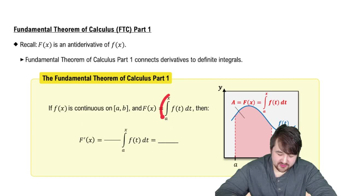
Integral Calculus

Integral calculus is a branch of mathematics that deals with the concept of integration, which is the process of finding the integral of a function. It is used to calculate areas under curves, volumes, and other quantities that can be represented as the accumulation of infinitesimal changes. Understanding how to evaluate integrals is crucial for solving problems involving continuous functions.
Video consigliato:
Percorso guidato
06:11
Fundamental Theorem of Calculus Part 1

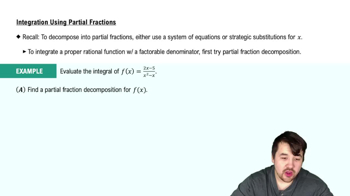
Partial Fractions

Partial fraction decomposition is a technique used to break down complex rational functions into simpler fractions that are easier to integrate. This method is particularly useful when dealing with integrals of rational functions, as it allows for the integration of each simpler fraction separately. However, it is not always the best approach for all types of integrals, especially those involving square roots.
Video consigliato:
Percorso guidato
08:01
Integration Using Partial Fractions

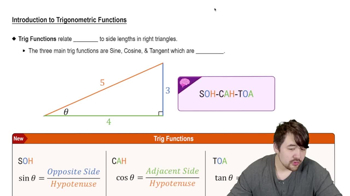
Trigonometric Substitution

Trigonometric substitution is a method used to evaluate integrals involving square roots of quadratic expressions. By substituting a variable with a trigonometric function, the integral can often be simplified into a more manageable form. In the case of the integral ∫dx/√(x² − 100), using trigonometric substitution is more appropriate than partial fractions, as it directly addresses the square root in the denominator.
Video consigliato:
Percorso guidato
6:04
Introduction to Trigonometric Functions