Ch. 8 - Integration Techniques
Briggs - Calculus: Early Transcendentals 3rd Edition
Briggs3rd EditionCalculus: Early TranscendentalsISBN: 9780136847243Non è quello che usi tu?Cambia libro di testo
Capitolo 8, Problema 8.R.15

2–74. Integration techniques Use the methods introduced in Sections 8.1 through 8.5 to evaluate the following integrals.
15. ∫ (from 1 to 2) (3x⁵ + 48x³ + 3x² + 16)/(x³ + 16x) dx

Guida verificata passo dopo passo
1
Step 1: Simplify the integrand by factoring the denominator. The denominator is \(x^3 + 16x\), which can be factored as \(x(x^2 + 16)\). Rewrite the integrand as \((3x^5 + 48x^3 + 3x^2 + 16) / (x(x^2 + 16))\).
Step 2: Break the integrand into partial fractions. Express the numerator \(3x^5 + 48x^3 + 3x^2 + 16\) as a sum of terms that can be divided by \(x(x^2 + 16)\). This involves finding constants \(A, B, C\) such that \(\frac{A}{x} + \frac{Bx + C}{x^2 + 16}\) equals the original fraction.
Step 3: Solve for the constants \(A, B, C\) by equating coefficients after multiplying through by the denominator \(x(x^2 + 16)\). This step involves algebraic manipulation to match terms on both sides of the equation.
Step 4: Integrate each term separately. The term \(\frac{A}{x}\) integrates to \(A \ln|x|\), and the term \(\frac{Bx + C}{x^2 + 16}\) can be split further into simpler integrals using substitution techniques or standard integral formulas for rational functions.
Step 5: Evaluate the definite integral by substituting the limits of integration (from \(x = 1\) to \(x = 2\)) into the antiderivative obtained in Step 4. Simplify the result to complete the solution.

Risposta video verificata per un problema simile:

Questa soluzione video è stata consigliata dai nostri tutor come utile per risolvere questo problema.
Durata del video:
7m

Concetti chiave

Ecco i concetti essenziali che devi comprendere per rispondere correttamente alla domanda.

Integration Techniques

Integration techniques are methods used to find the integral of a function. Common techniques include substitution, integration by parts, and partial fraction decomposition. Understanding these methods is crucial for evaluating complex integrals, as they allow for simplification and easier computation.
Video consigliato:
Percorso guidato
06:18
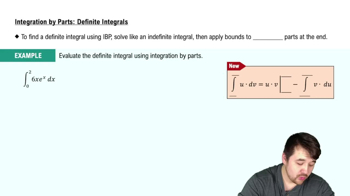
Integration by Parts for Definite Integrals

Definite Integrals

A definite integral calculates the area under a curve between two specified limits. It is represented as ∫ from a to b f(x) dx, where 'a' and 'b' are the bounds of integration. The result of a definite integral is a numerical value that represents the accumulated quantity over the interval.
Video consigliato:
Percorso guidato
05:43
Definition of the Definite Integral

Polynomial Functions

Polynomial functions are expressions that involve variables raised to whole number powers, combined using addition, subtraction, and multiplication. In the given integral, the numerator and denominator are polynomials, and understanding their behavior is essential for applying integration techniques effectively, especially when simplifying the integrand.
Video consigliato:
07:00
Taylor Polynomials