
Ch. 8 - Integration Techniques
Briggs - Calculus: Early Transcendentals 3rd Edition
Briggs3rd EditionCalculus: Early TranscendentalsISBN: 9780136847243Non è quello che usi tu?Cambia libro di testo
Capitolo 8, Problema 8.9.112c

Gaussians An important function in statistics is the Gaussian (or normal distribution, or bell-shaped curve), f(x) = e^(-ax²).
c. Complete the square to evaluate ∫ from -∞ to ∞ of e^(-(ax² + bx + c)) dx, where a > 0, b, and c are real numbers.

Guida verificata passo dopo passo
1
Start with the integral \( \int_{-\infty}^{\infty} e^{-(ax^2 + bx + c)} \, dx \), where \(a > 0\), and \(b, c\) are real numbers.
To simplify the exponent, complete the square for the quadratic expression \(ax^2 + bx + c\). Factor out \(a\) from the terms involving \(x\): \(ax^2 + bx + c = a\left(x^2 + \frac{b}{a}x\right) + c\).
Next, complete the square inside the parentheses: \(x^2 + \frac{b}{a}x = \left(x + \frac{b}{2a}\right)^2 - \left(\frac{b}{2a}\right)^2\). Substitute this back to get \(ax^2 + bx + c = a\left(x + \frac{b}{2a}\right)^2 - a\left(\frac{b}{2a}\right)^2 + c\).
Rewrite the integral using the completed square form: \(\int_{-\infty}^{\infty} e^{-\left[a\left(x + \frac{b}{2a}\right)^2 - a\left(\frac{b}{2a}\right)^2 + c\right]} \, dx = \int_{-\infty}^{\infty} e^{-a\left(x + \frac{b}{2a}\right)^2} e^{a\left(\frac{b}{2a}\right)^2 - c} \, dx\).
Since \(e^{a\left(\frac{b}{2a}\right)^2 - c}\) is a constant with respect to \(x\), factor it out of the integral. Then, perform the substitution \(u = x + \frac{b}{2a}\), which does not change the limits of integration because they are infinite. The integral reduces to \(e^{a\left(\frac{b}{2a}\right)^2 - c} \int_{-\infty}^{\infty} e^{-a u^2} \, du\), which is a standard Gaussian integral.

Risposta video verificata per un problema simile:

Questa soluzione video è stata consigliata dai nostri tutor come utile per risolvere questo problema.
Durata del video:
6m

Concetti chiave

Ecco i concetti essenziali che devi comprendere per rispondere correttamente alla domanda.

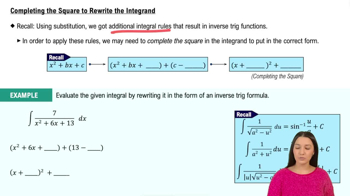
Completing the Square

Completing the square is a technique used to rewrite a quadratic expression in the form ax² + bx + c as a perfect square plus a constant. This simplifies integration and other operations by transforming the expression into a form like a(x + d)² + e, making it easier to handle exponential functions involving quadratics.
Video consigliato:
05:22
Completing the Square to Rewrite the Integrand

Gaussian Integral

The Gaussian integral refers to the integral of the function e^(-ax²) over the entire real line, which evaluates to √(π/a) for a > 0. This result is fundamental in probability and statistics, especially for normal distributions, and serves as a basis for evaluating more complex integrals involving quadratic exponents.
Video consigliato:
Percorso guidato
06:18
Integration by Parts for Definite Integrals

Properties of Exponential Functions

Exponential functions with quadratic exponents, such as e^(-(ax² + bx + c)), can be manipulated using algebraic techniques like completing the square. Understanding how to factor and rewrite these functions is essential for integrating them, as it allows the integral to be expressed in terms of known Gaussian integrals.
Video consigliato:
Percorso guidato
06:21
Properties of Functions