Ch. 8 - Integration Techniques
Briggs - Calculus: Early Transcendentals 3rd Edition
Briggs3rd EditionCalculus: Early TranscendentalsISBN: 9780136847243Non è quello che usi tu?Cambia libro di testo
Capitolo 8, Problema 8.1.4

Let f(x) = (4x³ + x² + 4x + 2) / (x² + 1). Use long division to show that f(x) = 4x + 1 + 1 / (x² + 1) and use this result to evaluate ∫f(x) dx.

Guida verificata passo dopo passo
1
Step 1: Begin by performing polynomial long division to divide the numerator (4x³ + x² + 4x + 2) by the denominator (x² + 1). Start by dividing the leading term of the numerator (4x³) by the leading term of the denominator (x²), which gives 4x.
Step 2: Multiply the entire denominator (x² + 1) by 4x, resulting in 4x³ + 4x. Subtract this result from the numerator (4x³ + x² + 4x + 2), leaving a remainder of x² + 2.
Step 3: Next, divide the new leading term of the remainder (x²) by the leading term of the denominator (x²), which gives 1. Multiply the denominator (x² + 1) by 1, resulting in x² + 1. Subtract this from the remainder (x² + 2), leaving a final remainder of 1.
Step 4: Combine the results of the division. The quotient is 4x + 1, and the remainder is 1. Therefore, the original function can be expressed as f(x) = 4x + 1 + 1 / (x² + 1).
Step 5: To evaluate ∫f(x) dx, split the integral into three parts: ∫(4x) dx, ∫(1) dx, and ∫(1 / (x² + 1)) dx. Use basic integration rules for each term: ∫(4x) dx = 2x², ∫(1) dx = x, and ∫(1 / (x² + 1)) dx = arctan(x). Combine these results to express the integral of f(x).

Risposta video verificata per un problema simile:

Questa soluzione video è stata consigliata dai nostri tutor come utile per risolvere questo problema.
Durata del video:
4m

Concetti chiave

Ecco i concetti essenziali che devi comprendere per rispondere correttamente alla domanda.

Polynomial Long Division

Polynomial long division is a method used to divide a polynomial by another polynomial of lower degree. It involves dividing the leading term of the dividend by the leading term of the divisor, multiplying the entire divisor by this result, and subtracting it from the dividend. This process is repeated until the degree of the remainder is less than that of the divisor. Understanding this technique is essential for simplifying rational functions like f(x) in the given question.
Video consigliato:
07:00
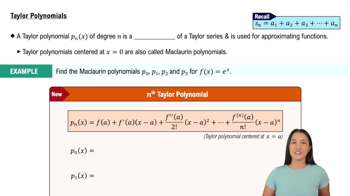
Taylor Polynomials

Integration of Rational Functions

Integrating rational functions often involves breaking them down into simpler components, typically through polynomial long division and partial fraction decomposition. Once a rational function is expressed in a simpler form, integration can be performed term by term. In this case, after simplifying f(x), the integral can be evaluated more easily, allowing for straightforward application of basic integration rules.
Video consigliato:
6:04
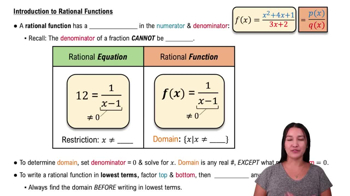
Intro to Rational Functions

Fundamental Theorem of Calculus

The Fundamental Theorem of Calculus links the concept of differentiation with integration, stating that if a function is continuous on an interval, then the integral of its derivative over that interval equals the change in the function's values at the endpoints. This theorem is crucial for evaluating definite integrals and understanding the relationship between a function and its antiderivative, which is relevant when finding ∫f(x) dx in the question.
Video consigliato:
Percorso guidato
06:11
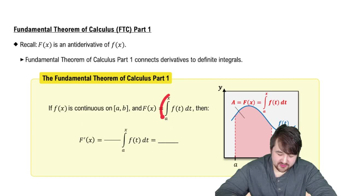
Fundamental Theorem of Calculus Part 1