Ch. 9 - Differential Equations
Briggs - Calculus: Early Transcendentals 3rd Edition
Briggs3rd EditionCalculus: Early TranscendentalsISBN: 9780136847243Non è quello che usi tu?Cambia libro di testo
Capitolo 9, Problema 9.R.6

2–10. General solutions Use the method of your choice to find the general solution of the following differential equations.
y′(t) = √(y/t)

Guida verificata passo dopo passo
1
Rewrite the differential equation \(y'(t) = \sqrt{\frac{y}{t}}\) in Leibniz notation as \(\frac{dy}{dt} = \sqrt{\frac{y}{t}}\) to clearly see the relationship between \(y\) and \(t\).
Recognize that the equation is separable, meaning you can rearrange terms to isolate \(y\) on one side and \(t\) on the other. Start by expressing \(\frac{dy}{dt} = \frac{\sqrt{y}}{\sqrt{t}}\).
Separate variables by writing \(\frac{dy}{\sqrt{y}} = \frac{dt}{\sqrt{t}}\). This allows you to integrate both sides with respect to their own variables.
Integrate both sides: \(\int \frac{1}{\sqrt{y}} \, dy = \int \frac{1}{\sqrt{t}} \, dt\). Recall that \(\int y^{-1/2} dy = 2\sqrt{y} + C\) and similarly for \(t\).
After integrating, solve the resulting equation for \(y\) to express the general solution explicitly in terms of \(t\) and an arbitrary constant of integration.

Risposta video verificata per un problema simile:

Questa soluzione video è stata consigliata dai nostri tutor come utile per risolvere questo problema.
Durata del video:
3m

Concetti chiave

Ecco i concetti essenziali che devi comprendere per rispondere correttamente alla domanda.

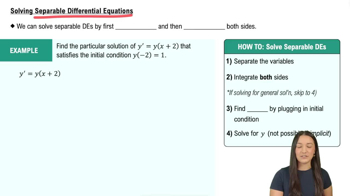
Separable Differential Equations

A separable differential equation can be written as a product of a function of t and a function of y, allowing the variables to be separated on opposite sides of the equation. This enables integration with respect to each variable independently to find the general solution.
Video consigliato:
06:06
Solving Separable Differential Equations

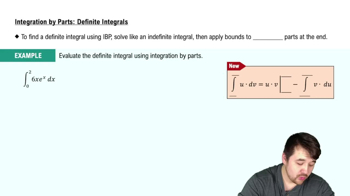
Integration Techniques

Solving separable equations requires integrating both sides after separation. Familiarity with basic integration rules, including power functions and substitution, is essential to evaluate the integrals and express the solution explicitly or implicitly.
Video consigliato:
Percorso guidato
06:18
Integration by Parts for Definite Integrals

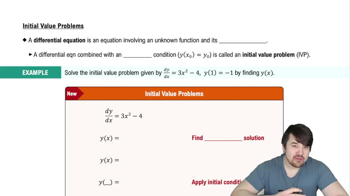
Initial Conditions and General Solutions

The general solution of a differential equation includes an arbitrary constant representing a family of solutions. Understanding how to interpret and apply initial conditions helps specify a unique solution from this family.
Video consigliato:
Percorso guidato
05:03
Initial Value Problems
Pratica correlata
Domanda del libro di testo

Explain why or why not Determine whether the following statements are true and give an explanation or counterexample.

a. The differential equation y′+2y=t is first-order, linear, and separable.

47
views

Domanda del libro di testo

Logistic growth in India The population of India was 435 million in 1960 (t=0) and 487 million in 1965 (t=5). The projected population for 2050 is 1.57 billion.

b. Use the solution of the logistic equation and the 2050 projected population to determine the carrying capacity.

52
views
Domanda del libro di testo

Explain why or why not Determine whether the following statements are true and give an explanation or counterexample.

d. The direction field for the differential equation y′(t)=t+y(t) is plotted in the ty-plane.

34
views
Domanda del libro di testo

Logistic growth The population of a rabbit community is governed by the initial value problem

P′(t) = 0.2 P (1 − P/1200), P(0) = 50

d. What is the population when the growth rate is a maximum?

44
views
Domanda del libro di testo

A first-order equation Consider the equation t² y′(t) + 2ty(t) = e⁻ᵗ

c. Find the solution that satisfies the condition y(1) = 0

46
views
Domanda del libro di testo

Stirred tank reaction A 100-L tank is filled with pure water when an inflow pipe is opened and a sugar solution with a concentration of 20 gm/L flows into the tank at a rate of 0.5 L/min. The solution is thoroughly mixed and flows out of the tank at a rate of 0.5 L/min.


c. At what time does the mass of sugar reach 95% of its steady-state level?

52
views