Ch. 9 - Differential Equations
Briggs - Calculus: Early Transcendentals 3rd Edition
Briggs3rd EditionCalculus: Early TranscendentalsISBN: 9780136847243Non è quello che usi tu?Cambia libro di testo
Capitolo 9, Problema 9.RE.1d

Explain why or why not Determine whether the following statements are true and give an explanation or counterexample.
d. The direction field for the differential equation y′(t)=t+y(t) is plotted in the ty-plane.

Guida verificata passo dopo passo
1
Recall that a direction field (or slope field) for a differential equation of the form \(y'(t) = f(t, y)\) is a graphical representation that shows the slope of the solution curve at each point \((t, y)\) in the \(ty\)-plane.
In this problem, the differential equation is \(y'(t) = t + y(t)\), where the slope at any point depends on both the independent variable \(t\) and the dependent variable \(y\).
Since the slope depends on both \(t\) and \(y\), the direction field must be plotted in the \(ty\)-plane, where the horizontal axis represents \(t\) and the vertical axis represents \(y\).
At each point \((t, y)\) in this plane, a small line segment is drawn with slope equal to \(t + y\), visually indicating the direction of the solution curve passing through that point.
Therefore, the statement is true because the direction field for \(y'(t) = t + y(t)\) is indeed plotted in the \(ty\)-plane.

Risposta video verificata per un problema simile:

Questa soluzione video è stata consigliata dai nostri tutor come utile per risolvere questo problema.
Durata del video:
2m

Concetti chiave

Ecco i concetti essenziali che devi comprendere per rispondere correttamente alla domanda.

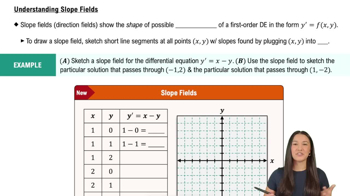
Direction Fields for Differential Equations

A direction field (or slope field) is a graphical representation of a first-order differential equation, showing small line segments with slopes given by the equation at various points. It helps visualize the behavior of solutions without solving the equation explicitly.
Video consigliato:
05:45
Understanding Slope Fields

Independent and Dependent Variables in Differential Equations

In a differential equation y'(t) = f(t, y), t is the independent variable (often representing time), and y(t) is the dependent variable. The direction field is typically plotted in the plane with axes representing these variables, usually the t-y plane.
Video consigliato:
07:39
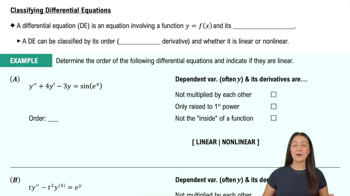
Classifying Differential Equations

Interpreting the ty-plane vs. t-y Plane

The notation 'ty-plane' can be ambiguous; the standard convention is to plot the direction field in the t-y plane, where the horizontal axis is t and the vertical axis is y. Understanding this helps determine if the statement about plotting in the 'ty-plane' is correct or not.
Video consigliato:
04:47
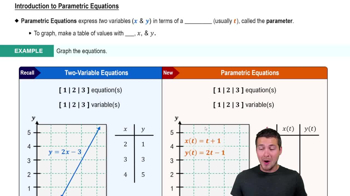
Introduction to Parametric Equations
Pratica correlata
Domanda del libro di testo

Explain why or why not Determine whether the following statements are true and give an explanation or counterexample.

a. The differential equation y′+2y=t is first-order, linear, and separable.

47
views

Domanda del libro di testo

Logistic growth in India The population of India was 435 million in 1960 (t=0) and 487 million in 1965 (t=5). The projected population for 2050 is 1.57 billion.

b. Use the solution of the logistic equation and the 2050 projected population to determine the carrying capacity.

52
views
Domanda del libro di testo

2–10. General solutions Use the method of your choice to find the general solution of the following differential equations.

y′(t) = √(y/t)

34
views
Domanda del libro di testo

38–43. Equilibrium solutions A differential equation of the form y′(t)=f(y) is said to be autonomous (the function f depends only on y). The constant function y=y0 is an equilibrium solution of the equation provided f(y0)=0 (because then y'(t)=0 and the solution remains constant for all t). Note that equilibrium solutions correspond to horizontal lines in the direction field. Note also that for autonomous equations, the direction field is independent of t. Carry out the following analysis on the given equations.

a. Find the equilibrium solutions. 


y′(t) = y(2 - y)

84
views
Domanda del libro di testo

27–30. Predator-prey models Consider the following pairs of differential equations that model a predator-prey system with populations x and y. In each case, carry out the following steps.

a. Identify which equation corresponds to the predator and which corresponds to the prey.


x′(t) = −3x + xy, y′(t) = 2y − xy

72
views
Domanda del libro di testo

Stirred tank reaction A 100-L tank is filled with pure water when an inflow pipe is opened and a sugar solution with a concentration of 20 gm/L flows into the tank at a rate of 0.5 L/min. The solution is thoroughly mixed and flows out of the tank at a rate of 0.5 L/min.


c. At what time does the mass of sugar reach 95% of its steady-state level?

52
views