
Ch. 9 - Differential Equations
Briggs - Calculus: Early Transcendentals 3rd Edition
Briggs3rd EditionCalculus: Early TranscendentalsISBN: 9780136847243Non è quello che usi tu?Cambia libro di testo
Capitolo 9, Problema 9.R.3

2–10. General solutions Use the method of your choice to find the general solution of the following differential equations.
y′(t) + 2y = 6

Guida verificata passo dopo passo
1
Identify the type of differential equation. The given equation \(y'(t) + 2y = 6\) is a first-order linear ordinary differential equation.
Rewrite the equation in the standard linear form: \(y' + P(t)y = Q(t)\), where \(P(t) = 2\) and \(Q(t) = 6\).
Find the integrating factor (IF) using the formula \(\mu(t) = e^{\int P(t)\,dt}\). Here, calculate \(\mu(t) = e^{\int 2\,dt} = e^{2t}\).
Multiply both sides of the differential equation by the integrating factor \(e^{2t}\) to get \(e^{2t}y' + 2e^{2t}y = 6e^{2t}\). Notice that the left side is the derivative of \(e^{2t}y\).
Integrate both sides with respect to \(t\): \(\int \frac{d}{dt}(e^{2t}y)\,dt = \int 6e^{2t}\,dt\). Then solve for \(y(t)\) by dividing by \(e^{2t}\) and include the constant of integration.

Risposta video verificata per un problema simile:

Questa soluzione video è stata consigliata dai nostri tutor come utile per risolvere questo problema.
Durata del video:
2m

Concetti chiave

Ecco i concetti essenziali che devi comprendere per rispondere correttamente alla domanda.

First-Order Linear Differential Equations

These are differential equations of the form y' + p(t)y = q(t), where y' is the derivative of y with respect to t. They can be solved using integrating factors or other methods to find the general solution that satisfies the equation for all t.
Video consigliato:
07:39
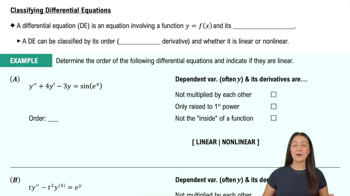
Classifying Differential Equations

Integrating Factor Method

This technique involves multiplying the entire differential equation by an integrating factor, usually e^(∫p(t)dt), to rewrite the left side as the derivative of a product. This simplifies solving the equation by allowing direct integration to find y(t).
Video consigliato:
07:33
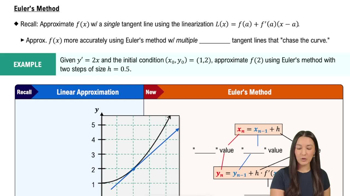
Euler's Method

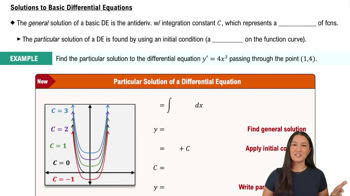
General Solution of Differential Equations

The general solution includes all possible solutions of a differential equation and typically contains an arbitrary constant. It represents the family of functions that satisfy the equation, encompassing both particular and homogeneous solutions.
Video consigliato:
04:00
Solutions to Basic Differential Equations