
Ch. 9 - Differential Equations
Briggs - Calculus: Early Transcendentals 3rd Edition
Briggs3rd EditionCalculus: Early TranscendentalsISBN: 9780136847243Non è quello che usi tu?Cambia libro di testo
Capitolo 9, Problema 9.R.23

22–25. Equilibrium solutions Find the equilibrium solutions of the following equations and determine whether each solution is stable or unstable.
y′(t) = y(3+y)(y-5)

Guida verificata passo dopo passo
1
Identify the equilibrium solutions by setting the derivative equal to zero: solve the equation \(y'(t) = y(3 + y)(y - 5) = 0\) for \(y\).
Find the values of \(y\) that satisfy \(y = 0\), \(3 + y = 0\), and \(y - 5 = 0\). These will give the equilibrium points.
Determine the stability of each equilibrium by analyzing the sign of \(y'(t)\) around each equilibrium point. This can be done by choosing test values slightly less and greater than each equilibrium and evaluating the sign of \(y'(t)\).
Alternatively, compute the derivative of the right-hand side function \(f(y) = y(3 + y)(y - 5)\) with respect to \(y\), denoted \(f'(y)\), and evaluate it at each equilibrium point. The sign of \(f'(y)\) at the equilibrium indicates stability: if \(f'(y) < 0\), the equilibrium is stable; if \(f'(y) > 0\), it is unstable.
Summarize the equilibrium points along with their stability classification based on the sign analysis or derivative test.

Risposta video verificata per un problema simile:

Questa soluzione video è stata consigliata dai nostri tutor come utile per risolvere questo problema.
Durata del video:
4m

Concetti chiave

Ecco i concetti essenziali che devi comprendere per rispondere correttamente alla domanda.

Equilibrium Solutions

Equilibrium solutions are constant solutions to a differential equation where the derivative equals zero. For y′(t) = f(y), these occur at values of y where f(y) = 0. They represent points where the system remains steady over time.
Video consigliato:
04:00
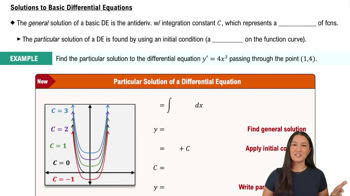
Solutions to Basic Differential Equations

Stability of Equilibrium Solutions

Stability refers to whether solutions near an equilibrium point move towards or away from it over time. If small perturbations decay and solutions return to equilibrium, it is stable; if they grow away, it is unstable. This is often analyzed using the sign of the derivative of f(y) at the equilibrium.
Video consigliato:
04:00
Solutions to Basic Differential Equations

Sign Analysis of the Derivative Function

To determine stability, analyze the sign of f(y) = y(3+y)(y-5) around equilibrium points. By checking intervals between roots, you can see if solutions increase or decrease, indicating whether the equilibrium attracts or repels nearby solutions.
Video consigliato:
06:30
Derivatives of Other Trig Functions