Ch. 9 - Differential Equations
Briggs - Calculus: Early Transcendentals 3rd Edition
Briggs3rd EditionCalculus: Early TranscendentalsISBN: 9780136847243Non è quello che usi tu?Cambia libro di testo
Capitolo 9, Problema 9.1.30

21–32. Finding general solutions Find the general solution of each differential equation. Use C,C1,C2... to denote arbitrary constants.
y'(t) = t lnt + 1

Guida verificata passo dopo passo
1
Recognize that the given differential equation is a first-order ordinary differential equation of the form \(y'(t) = f(t)\), where \(f(t) = t \ln t + 1\).
To find the general solution, integrate both sides with respect to \(t\): \(y(t) = \int (t \ln t + 1) \, dt + C\), where \(C\) is an arbitrary constant.
Split the integral into two parts: \(\int t \ln t \, dt\) and \(\int 1 \, dt\).
Use integration by parts to solve \(\int t \ln t \, dt\). Let \(u = \ln t\) and \(dv = t \, dt\), then find \(du\) and \(v\) accordingly.
After computing the integrals, combine the results and add the constant \(C\) to write the general solution \(y(t)\).

Risposta video verificata per un problema simile:

Questa soluzione video è stata consigliata dai nostri tutor come utile per risolvere questo problema.
Durata del video:
3m

Concetti chiave

Ecco i concetti essenziali che devi comprendere per rispondere correttamente alla domanda.

Ordinary Differential Equations (ODEs)

An ordinary differential equation relates a function and its derivatives with respect to one variable. Solving an ODE involves finding a function that satisfies the equation, often including arbitrary constants representing a family of solutions.
Video consigliato:
07:39
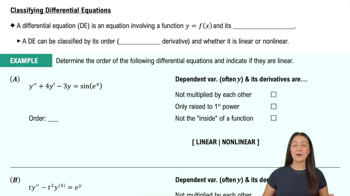
Classifying Differential Equations

Integration of Functions

To solve first-order ODEs like y'(t) = f(t), we integrate the right-hand side with respect to t. Integration reverses differentiation and introduces an arbitrary constant, representing the general solution's family.
Video consigliato:
05:11
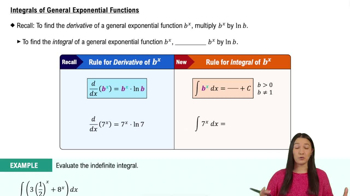
Integrals of General Exponential Functions

Properties of Logarithmic Functions

Understanding the natural logarithm function ln(t) and its behavior is essential when integrating expressions like t ln(t). Techniques such as integration by parts are often used to integrate products involving logarithms.
Video consigliato:
Percorso guidato
06:21
Properties of Functions
Pratica correlata
Domanda del libro di testo

17–32. Solving initial value problems Determine whether the following equations are separable. If so, solve the initial value problem.

y'(t) = y³sin t, y(0) = 1

59
views

Domanda del libro di testo

7–16. Verifying general solutions Verify that the given function is a solution of the differential equation that follows it. Assume C, C1, C2 and C3 are arbitrary constants.

u(t) = C₁eᵗ + C₂teᵗ; u''(t) - 2u'(t) + u(t) = 0

41
views
Domanda del libro di testo

7–16. Verifying general solutions Verify that the given function is a solution of the differential equation that follows it. Assume C, C1, C2 and C3 are arbitrary constants.

y(t) = C₁ sin4t + C₂ cos4t; y''(t) + 16y(t) = 0

52
views
Domanda del libro di testo

5–10. First-order linear equations Find the general solution of the following equations.


v'(y) − v/2 = 14

49
views
Domanda del libro di testo

Orthogonal trajectories Use the method in Exercise 44 to find the orthogonal trajectories for the family of circles x² + y² = a²

110
views
Domanda del libro di testo

45–48. General first-order linear equations Consider the general first-order linear equation y'(t)+a(t)y(t)=f(t). This equation can be solved, in principle, by defining the integrating factor p(t)=exp(∫a(t)dt). Here is how the integrating factor works. Multiply both sides of the equation by p (which is always positive) and show that the left side becomes an exact derivative. Therefore, the equation becomes


p(t)(y′(t) + a(t)y(t)) = d/dt(p(t)y(t)) = p(t)f(t).


Now integrate both sides of the equation with respect to t to obtain the solution. Use this method to solve the following initial value problems. Begin by computing the required integrating factor.


y′(t) + (2t)/(t² + 1)y(t) = 1 + 3t², y(1) = 4

75
views