Ch. 9 - Differential Equations
Briggs - Calculus: Early Transcendentals 3rd Edition
Briggs3rd EditionCalculus: Early TranscendentalsISBN: 9780136847243Non è quello che usi tu?Cambia libro di testo
Capitolo 9, Problema 9.1.12

7–16. Verifying general solutions Verify that the given function is a solution of the differential equation that follows it. Assume C, C1, C2 and C3 are arbitrary constants.
u(t) = C₁eᵗ + C₂teᵗ; u''(t) - 2u'(t) + u(t) = 0

Guida verificata passo dopo passo
1
Identify the given function: \(u(t) = C_1 e^t + C_2 t e^t\), where \(C_1\) and \(C_2\) are arbitrary constants.
Compute the first derivative \(u'(t)\) using the product rule for the term \(C_2 t e^t\): \(u'(t) = \frac{d}{dt}(C_1 e^t) + \frac{d}{dt}(C_2 t e^t) = C_1 e^t + C_2 \left( e^t + t e^t \right)\).
Simplify the first derivative: \(u'(t) = C_1 e^t + C_2 e^t + C_2 t e^t = (C_1 + C_2) e^t + C_2 t e^t\).
Compute the second derivative \(u''(t)\) by differentiating \(u'(t)\) again, applying the product rule to the \(C_2 t e^t\) term: \(u''(t) = \frac{d}{dt} \left( (C_1 + C_2) e^t + C_2 t e^t \right) = (C_1 + C_2) e^t + C_2 \left( e^t + t e^t \right)\).
Substitute \(u(t)\), \(u'(t)\), and \(u''(t)\) into the differential equation \(u''(t) - 2 u'(t) + u(t) = 0\) and simplify the expression. If the left-hand side simplifies to zero for all \(t\), then \(u(t)\) is a solution to the differential equation.

Risposta video verificata per un problema simile:

Questa soluzione video è stata consigliata dai nostri tutor come utile per risolvere questo problema.
Durata del video:
11m

Concetti chiave

Ecco i concetti essenziali che devi comprendere per rispondere correttamente alla domanda.

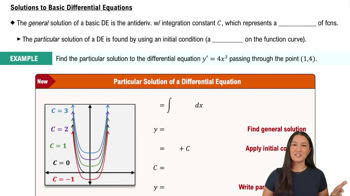
General Solution of a Differential Equation

The general solution of a differential equation includes all possible solutions and typically contains arbitrary constants. It represents the complete set of functions that satisfy the equation, allowing for initial conditions to specify a unique solution.
Video consigliato:
04:00
Solutions to Basic Differential Equations

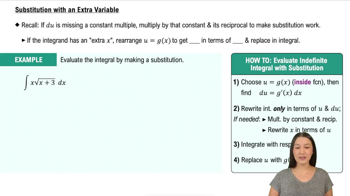
Verification by Substitution

To verify a solution, substitute the given function and its derivatives into the differential equation. If the equation holds true for all values in the domain, the function is a valid solution.
Video consigliato:
04:27
Substitution With an Extra Variable

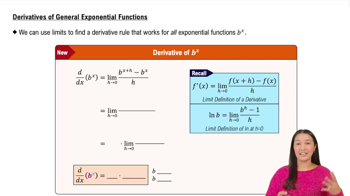
Derivatives of Exponential Functions

Understanding how to compute derivatives of functions involving exponentials and products, such as te^t, is essential. Use the product rule for derivatives when differentiating terms like C₂teᵗ.
Video consigliato:
04:50
Derivatives of General Exponential Functions
Pratica correlata
Domanda del libro di testo

17–32. Solving initial value problems Determine whether the following equations are separable. If so, solve the initial value problem.

y'(t) = y³sin t, y(0) = 1

59
views

Domanda del libro di testo

Explain how the growth rate function determines the solution of a population model.

40
views
Domanda del libro di testo

The general solution of a first-order linear differential equation is y(t) = Ce⁻¹⁰ᵗ − 13. What solution satisfies the initial condition y(0) = 4?

84
views
Domanda del libro di testo

9–14. Growth rate functions Make a sketch of the population function P (as a function of time) that results from the following growth rate functions. Assume the population at time t = 0 begins at some positive value.


39
views
Domanda del libro di testo

45–48. General first-order linear equations Consider the general first-order linear equation y'(t)+a(t)y(t)=f(t). This equation can be solved, in principle, by defining the integrating factor p(t)=exp(∫a(t)dt). Here is how the integrating factor works. Multiply both sides of the equation by p (which is always positive) and show that the left side becomes an exact derivative. Therefore, the equation becomes


p(t)(y′(t) + a(t)y(t)) = d/dt(p(t)y(t)) = p(t)f(t).


Now integrate both sides of the equation with respect to t to obtain the solution. Use this method to solve the following initial value problems. Begin by computing the required integrating factor.


y′(t) + (2t)/(t² + 1)y(t) = 1 + 3t², y(1) = 4

75
views
Domanda del libro di testo

21–32. Finding general solutions Find the general solution of each differential equation. Use C,C1,C2... to denote arbitrary constants.

y'(t) = t lnt + 1

38
views