
Ch. 9 - Differential Equations
Briggs - Calculus: Early Transcendentals 3rd Edition
Briggs3rd EditionCalculus: Early TranscendentalsISBN: 9780136847243Non è quello che usi tu?Cambia libro di testo
Capitolo 9, Problema 9.1.27

21–32. Finding general solutions Find the general solution of each differential equation. Use C,C1,C2... to denote arbitrary constants.
u''(x) = 55x⁹ + 36x⁷ - 21x⁵ + 10x⁻³

Guida verificata passo dopo passo
1
Recognize that the given differential equation is a second-order ordinary differential equation of the form \(u''(x) = f(x)\), where \(f(x) = 55x^{9} + 36x^{7} - 21x^{5} + 10x^{-3}\).
To find the general solution \(u(x)\), integrate the right-hand side function \(f(x)\) twice with respect to \(x\). The first integration will give \(u'(x)\), and the second integration will give \(u(x)\).
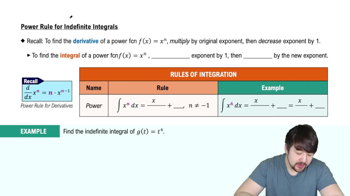
Perform the first integration: calculate \(u'(x) = \int (55x^{9} + 36x^{7} - 21x^{5} + 10x^{-3}) \, dx\). Integrate each term separately using the power rule for integration, which states \(\int x^{n} \, dx = \frac{x^{n+1}}{n+1} + C\) for \(n \neq -1\).
After finding \(u'(x)\), perform the second integration: calculate \(u(x) = \int u'(x) \, dx\). Again, integrate each term separately and add a new arbitrary constant of integration.
Combine the results to write the general solution as $u(x) = $ (the expression from the second integration) \(+ C_1 x + C_2\), where \(C_1\) and \(C_2\) are arbitrary constants representing the general solution's family.

Risposta video verificata per un problema simile:

Questa soluzione video è stata consigliata dai nostri tutor come utile per risolvere questo problema.
Durata del video:
4m

Concetti chiave

Ecco i concetti essenziali che devi comprendere per rispondere correttamente alla domanda.

Second-Order Differential Equations

A second-order differential equation involves the second derivative of an unknown function. Solving such equations means finding a function whose second derivative satisfies the given equation. The general solution includes all possible functions that fit the equation, often expressed with arbitrary constants.
Video consigliato:
07:39
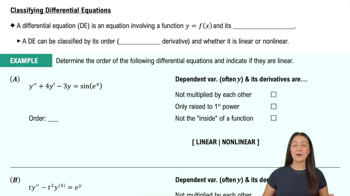
Classifying Differential Equations

Integration to Find General Solutions

To solve u''(x) = f(x), integrate the right-hand side twice with respect to x. Each integration introduces an arbitrary constant, reflecting the family of solutions. This process transforms the differential equation into an explicit formula for u(x).
Video consigliato:
05:11
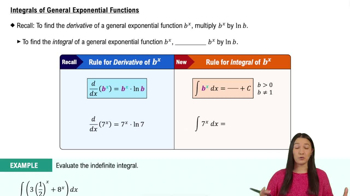
Integrals of General Exponential Functions

Handling Polynomial and Negative Powers in Integration

When integrating terms like x⁹ or x⁻³, apply the power rule: ∫x^n dx = x^(n+1)/(n+1) for n ≠ -1. For negative powers, ensure the integral is defined and carefully add constants. This technique is essential for integrating the given right-hand side accurately.
Video consigliato:
Percorso guidato
04:04
Power Rule for Indefinite Integrals