
Ch. 9 - Differential Equations
Briggs - Calculus: Early Transcendentals 3rd Edition
Briggs3rd EditionCalculus: Early TranscendentalsISBN: 9780136847243Non è quello che usi tu?Cambia libro di testo
Capitolo 9, Problema 9.2.27

25–28. Two steps of Euler’s method For the following initial value problems, compute the first two approximations u1 and u2 given by Euler’s method using the given time step.


y′(t) = 2−y, y(0) = 1; Δt = 0.1

Guida verificata passo dopo passo
1
Identify the differential equation and initial condition: \(y'(t) = 2 - y\), with \(y(0) = 1\).
Recall Euler's method formula for approximating solutions: \(u_{n+1} = u_n + \Delta t \cdot f(t_n, u_n)\), where \(f(t, y) = y'(t)\).
Calculate the first approximation \(u_1\) using \(t_0 = 0\), \(u_0 = 1\), and \(\Delta t = 0.1\): compute \(f(t_0, u_0) = 2 - u_0\) and then \(u_1 = u_0 + 0.1 \times f(t_0, u_0)\).
Calculate the second approximation \(u_2\) using \(t_1 = 0.1\), \(u_1\) from the previous step, and \(\Delta t = 0.1\): compute \(f(t_1, u_1) = 2 - u_1\) and then \(u_2 = u_1 + 0.1 \times f(t_1, u_1)\).
Summarize the results: \(u_1\) and \(u_2\) are the first two Euler approximations to the solution of the initial value problem at \(t = 0.1\) and \(t = 0.2\), respectively.

Risposta video verificata per un problema simile:

Questa soluzione video è stata consigliata dai nostri tutor come utile per risolvere questo problema.
Durata del video:
2m

Concetti chiave

Ecco i concetti essenziali che devi comprendere per rispondere correttamente alla domanda.

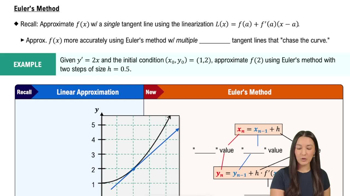
Euler's Method

Euler's method is a numerical technique to approximate solutions of first-order differential equations. It uses the slope at a known point to estimate the value of the function at the next point by moving a small step along the tangent line. This iterative process helps approximate the solution curve when an exact solution is difficult to find.
Video consigliato:
07:33
Euler's Method

Initial Value Problem (IVP)

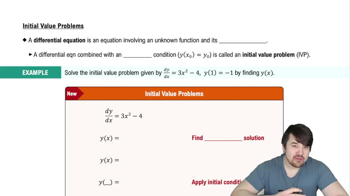
An initial value problem specifies a differential equation along with a starting value for the function at a given point. The goal is to find the function that satisfies both the differential equation and the initial condition. This setup is essential for applying numerical methods like Euler's method.
Video consigliato:
Percorso guidato
05:03
Initial Value Problems

Step Size (Δt) in Numerical Methods

The step size, Δt, determines the increments at which the solution is approximated in numerical methods. Smaller step sizes generally yield more accurate results but require more computations. Choosing an appropriate Δt balances accuracy and computational effort.
Video consigliato:
07:33
Euler's Method
Pratica correlata
Domanda del libro di testo

27–30. Newton’s Law of Cooling Solve the differential equation for Newton’s Law of Cooling to find the temperature function in the following cases. Then answer any additional questions.


A pot of boiling soup (100°C) is put in a cellar with a temperature of 10°C. After 30 minutes, the soup has cooled to 80°C. When will the temperature of the soup reach 30°C 

80
views
Domanda del libro di testo

Explain how a stirred tank reaction works.

44
views
Domanda del libro di testo

12–16. Sketching direction fields Use the window [-2, 2] x [-2, 2] to sketch a direction field for the following equations. Then sketch the solution curve that corresponds to the given initial condition. A detailed direction field is not needed.

y(x) = sin y, y(−2) = 1/2

59
views
Domanda del libro di testo

What are the assumptions underlying the predator-prey model discussed in this section?

96
views
Domanda del libro di testo

33–42. Solving initial value problems Solve the following initial value problems.

y'(x) = 4 sec² 2x, y(0) = 8

62
views
Domanda del libro di testo

39–42. Special equations A special class of first-order linear equations have the form a(t)y'(t)+a'(t)y(t)=f(t), where a and f are given functions of t. Notice that the left side of this equation can be written as the derivative of a product, so the equation has the form

a(t)y'(t) + a'(t)y(t) = d/dt (a(t)y(t)) = f(t). 

Therefore, the equation can be solved by integrating both sides with respect to t. Use this idea to solve the following initial value problems. 


t³y′(t) + 3t²y = (1 + t)/t, y(1) = 6

71
views