
Ch. 9 - Differential Equations
Briggs - Calculus: Early Transcendentals 3rd Edition
Briggs3rd EditionCalculus: Early TranscendentalsISBN: 9780136847243Non è quello che usi tu?Cambia libro di testo
Capitolo 9, Problema 9.2.29b

29–32. {Use of Tech} Errors in Euler’s method Consider the following initial value problems.


b. Using the exact solution given, compute the errors in the Euler approximations at t=0.2 and t=0.4.


y′(t) = −y, y(0) = 1; y(t) = e⁻ᵗ

Guida verificata passo dopo passo
1
Identify the given initial value problem (IVP): \(y'(t) = -y\), with initial condition \(y(0) = 1\), and the exact solution \(y(t) = e^{-t}\).
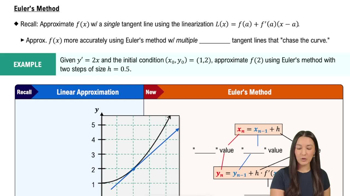
Recall that Euler's method approximates the solution using the formula: \(y_{n+1} = y_n + h f(t_n, y_n)\), where \(h\) is the step size and \(f(t, y) = y'(t)\).
Choose the step size \(h\) based on the points where the approximation is needed. Since we want approximations at \(t=0.2\) and \(t=0.4\), a natural choice is \(h=0.2\).
Compute the Euler approximations step-by-step: starting from \(t_0=0\), \(y_0=1\), calculate \(y_1\) at \(t_1=0.2\) and then \(y_2\) at \(t_2=0.4\) using the Euler update formula.
Calculate the exact values at \(t=0.2\) and \(t=0.4\) using \(y(t) = e^{-t}\), then find the errors by subtracting the Euler approximations from the exact values: \(\text{Error} = |y_{exact} - y_{Euler}|\) at each point.

Risposta video verificata per un problema simile:

Questa soluzione video è stata consigliata dai nostri tutor come utile per risolvere questo problema.
Durata del video:
5m

Concetti chiave

Ecco i concetti essenziali che devi comprendere per rispondere correttamente alla domanda.

Euler's Method

Euler's method is a numerical technique to approximate solutions of initial value problems for differential equations. It uses a stepwise approach, estimating the next value by moving along the slope given by the differential equation at the current point. This method is simple but can accumulate errors depending on the step size.
Video consigliato:
07:33
Euler's Method

Exact Solution of Differential Equations

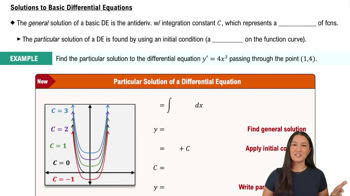
The exact solution is the precise function that satisfies the differential equation and initial conditions. In this problem, y(t) = e⁻ᵗ is the exact solution, which allows comparison with numerical approximations to evaluate their accuracy. Knowing the exact solution helps quantify the error in numerical methods.
Video consigliato:
04:00
Solutions to Basic Differential Equations

Error Analysis in Numerical Methods

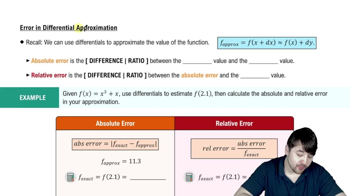
Error analysis involves calculating the difference between the exact solution and the numerical approximation at specific points. It helps assess the accuracy and reliability of methods like Euler's. Errors depend on factors like step size and the nature of the differential equation.
Video consigliato:
Percorso guidato
04:57
Determining Error and Relative Error
Pratica correlata
Domanda del libro di testo

42–43. Implicit solutions for separable equations For the following separable equations, carry out the indicated analysis.

b. Find the value of the arbitrary constant associated with each initial condition. (Each initial condition requires a different constant.)


y'(t) = t²/(y² + 1); y(−1) = 1, y(0) = 0, y(−1) = −1

79
views
Domanda del libro di testo

{Use of Tech} Intravenous drug dosing The amount of drug in the blood of a patient (in milligrams) administered via an intravenous line is governed by the initial value problem y’(t) = -0.02y + 3, y(0) = 0 where t is measured in hours.


b. What is the steady-state level of the drug?

38
views
Domanda del libro di testo

Explain why or why not Determine whether the following statements are true and give an explanation or counterexample


b. If k>0 and b>0 then y(t)=0 is never a solution of y'(t)=ky−b.

44
views
Domanda del libro di testo

33–36. {Use of Tech} Computing Euler approximations Use a calculator or computer program to carry out the following steps.

b. Using the exact solution (also given), find the error in the approximation to y(T) (only at the right endpoint of the time interval).


y′(t) = t/y, y(0) = 4; Δt = 0.1, T = 2; y(t) = √(t² + 16)

49
views
Domanda del libro di testo

Euler’s method on more general grids Suppose the solution of the initial value problem y'(t)=f(t,y),y(a)=A is to be approximated on the interval [a, b].

b. Write the first step of Euler’s method to compute u1.

74
views
Domanda del libro di testo

{Use of Tech} Torricelli’s law An open cylindrical tank initially filled with water drains through a hole in the bottom of the tank according to Torricelli’s law (see figure). If h(t) is the depth of water in the tank for t≥0 s, then Torricelli’s law implies h′(t)=−k√h, where k is a constant that includes g=9.8m/s², the radius of the tank, and the radius of the drain. Assume the initial depth of the water is h(0)=Hm. 

b. Find the solution in k=0.1the case that and H=0.5m. 

94
views