
Ch. 9 - Differential Equations
Briggs - Calculus: Early Transcendentals 3rd Edition
Briggs3rd EditionCalculus: Early TranscendentalsISBN: 9780136847243Non è quello che usi tu?Cambia libro di testo
Capitolo 9, Problema 9.3.42b

42–43. Implicit solutions for separable equations For the following separable equations, carry out the indicated analysis.
b. Find the value of the arbitrary constant associated with each initial condition. (Each initial condition requires a different constant.)


y'(t) = t²/(y² + 1); y(−1) = 1, y(0) = 0, y(−1) = −1

Guida verificata passo dopo passo
1
Start with the given differential equation: \(y'(t) = \frac{t^{2}}{y^{2} + 1}\). Recognize that this is a separable differential equation, meaning you can rewrite it to separate variables \(y\) and \(t\) on opposite sides.
Rewrite the equation by expressing \(y'(t)\) as \(\frac{dy}{dt}\) and separate variables: multiply both sides by $(y^{2} + 1) dt$ to get $(y^{2} + 1) dy = t^{2} dt$.
Integrate both sides: \(\int (y^{2} + 1) dy = \int t^{2} dt\). This will give you an implicit solution involving \(y\) and \(t\) plus an arbitrary constant \(C\).
After integrating, you will have an equation of the form \(\frac{y^{3}}{3} + y = \frac{t^{3}}{3} + C\). Use each initial condition to find the corresponding constant \(C\) by substituting the given \(t\) and \(y\) values into this equation.
Solve for \(C\) for each initial condition: for \(y(-1) = 1\), \(y(0) = 0\), and \(y(-1) = -1\), plug in the values and isolate \(C\). This gives you the specific constant for each initial condition.

Risposta video verificata per un problema simile:

Questa soluzione video è stata consigliata dai nostri tutor come utile per risolvere questo problema.
Durata del video:
3m

Concetti chiave

Ecco i concetti essenziali che devi comprendere per rispondere correttamente alla domanda.

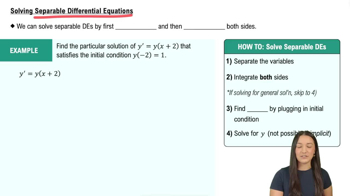
Separable Differential Equations

A separable differential equation can be written as dy/dt = g(t)h(y), allowing the variables y and t to be separated on opposite sides of the equation. This enables integration of each side independently to find an implicit or explicit solution. Recognizing separability is key to solving the given equation.
Video consigliato:
06:06
Solving Separable Differential Equations

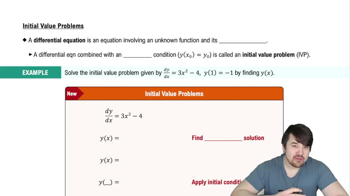
Initial Conditions and Arbitrary Constants

When solving differential equations, integration introduces an arbitrary constant representing a family of solutions. Applying initial conditions, such as y(t₀) = y₀, allows determination of the specific constant that fits each condition, yielding a unique solution curve for each initial value.
Video consigliato:
Percorso guidato
05:03
Initial Value Problems

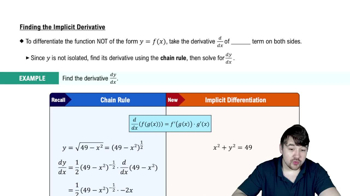
Implicit Solutions

Sometimes, after integrating, the solution cannot be explicitly solved for y in terms of t. Instead, the solution is given implicitly as a relation involving both variables and the constant of integration. Understanding how to work with implicit solutions is essential for interpreting and applying the results.
Video consigliato:
Percorso guidato
05:14
Finding The Implicit Derivative
Pratica correlata
Domanda del libro di testo

29–32. {Use of Tech} Errors in Euler’s method Consider the following initial value problems.


b. Using the exact solution given, compute the errors in the Euler approximations at t=0.2 and t=0.4.


y′(t) = −y, y(0) = 1; y(t) = e⁻ᵗ

63
views
Domanda del libro di testo

{Use of Tech} Intravenous drug dosing The amount of drug in the blood of a patient (in milligrams) administered via an intravenous line is governed by the initial value problem y’(t) = -0.02y + 3, y(0) = 0 where t is measured in hours.


b. What is the steady-state level of the drug?

38
views
Domanda del libro di testo

Euler’s method on more general grids Suppose the solution of the initial value problem y'(t)=f(t,y),y(a)=A is to be approximated on the interval [a, b].

b. Write the first step of Euler’s method to compute u1.

74
views
Domanda del libro di testo

27–30. Predator-prey models Consider the following pairs of differential equations that model a predator-prey system with populations x and y. In each case, carry out the following steps.

b. Find the lines along which x'(t) = 0. Find the lines along which y'(t) = 0.


x′(t) = 2x − xy, y′(t) = −y + xy

51
views
Domanda del libro di testo

brOrthogonal trajectories Two curves are orthogonal to each other if their tangent lines are perpendicular at each point of intersection. A family of curves forms orthogonal trajectories with another family of curves if each curve in one family is orthogonal to each curve in the other family. Use the following steps to find the orthogonal trajectories of the family of ellipses 2x² + y² = a²


b. The family of trajectories orthogonal to 2x² + y² = a² satisfies the differential equation dy/dx = y/(2x). Why?

81
views
Domanda del libro di testo

{Use of Tech} Torricelli’s law An open cylindrical tank initially filled with water drains through a hole in the bottom of the tank according to Torricelli’s law (see figure). If h(t) is the depth of water in the tank for t≥0 s, then Torricelli’s law implies h′(t)=−k√h, where k is a constant that includes g=9.8m/s², the radius of the tank, and the radius of the drain. Assume the initial depth of the water is h(0)=Hm. 

b. Find the solution in k=0.1the case that and H=0.5m. 

94
views