Ch. 9 - Differential Equations
Briggs - Calculus: Early Transcendentals 3rd Edition
Briggs3rd EditionCalculus: Early TranscendentalsISBN: 9780136847243Non è quello che usi tu?Cambia libro di testo
Capitolo 9, Problema 9.1.39

33–42. Solving initial value problems Solve the following initial value problems.
y''(t) = teᵗ, y(0) = 0, y'(0) = 1

Guida verificata passo dopo passo
1
Identify the given differential equation and initial conditions: \(y''(t) = t e^{t}\), with \(y(0) = 0\) and \(y'(0) = 1\).
Integrate the second derivative \(y''(t)\) once with respect to \(t\) to find the first derivative \(y'(t)\). This means computing \(y'(t) = \int t e^{t} \, dt + C_1\), where \(C_1\) is a constant of integration.
To integrate \(\int t e^{t} \, dt\), use integration by parts. Let \(u = t\) and $dv = e^{t} dt$, then find \(du\) and \(v\), and apply the formula \(\int u \, dv = uv - \int v \, du\).
After finding \(y'(t)\), use the initial condition \(y'(0) = 1\) to solve for the constant \(C_1\).
Integrate \(y'(t)\) with respect to \(t\) to find \(y(t)\), adding another constant of integration \(C_2\). Then use the initial condition \(y(0) = 0\) to solve for \(C_2\).

Risposta video verificata per un problema simile:

Questa soluzione video è stata consigliata dai nostri tutor come utile per risolvere questo problema.
Durata del video:
5m

Concetti chiave

Ecco i concetti essenziali che devi comprendere per rispondere correttamente alla domanda.

Second-Order Differential Equations

A second-order differential equation involves the second derivative of a function. Solving such equations requires finding a function y(t) whose second derivative matches the given expression, often involving integration and applying initial conditions.
Video consigliato:
07:39
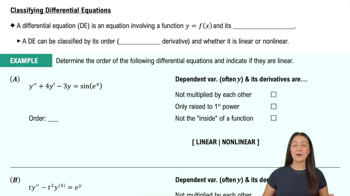
Classifying Differential Equations

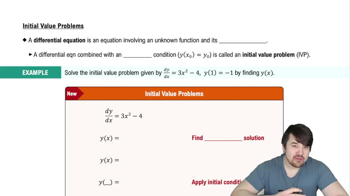
Initial Value Problems (IVPs)

An initial value problem specifies the values of a function and its derivatives at a particular point. These conditions allow us to determine the unique solution to a differential equation by solving for constants after integration.
Video consigliato:
Percorso guidato
05:03
Initial Value Problems

Integration of Non-Homogeneous Terms

When the differential equation includes a non-homogeneous term like te^t, solving involves integrating this term twice. Techniques such as integration by parts are often used to handle products of functions like t and e^t.
Video consigliato:
Percorso guidato
05:44
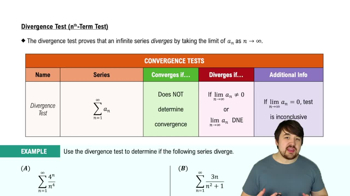
Divergence Test (nth Term Test)
Pratica correlata
Domanda del libro di testo

33–42. Solving initial value problems Solve the following initial value problems.

p'(x) = 2/(x² + x), p(1) = 0

48
views

Domanda del libro di testo

The general solution of a first-order linear differential equation is y(t) = Ce⁻¹⁰ᵗ − 13. What solution satisfies the initial condition y(0) = 4?

84
views
Domanda del libro di testo

9–14. Growth rate functions Make a sketch of the population function P (as a function of time) that results from the following growth rate functions. Assume the population at time t = 0 begins at some positive value.


22
views
Domanda del libro di testo

17–18. {Use of Tech} Designing logistic functions Use the method of Example 1 to find a logistic function that describes the following populations. Graph the population function.


The population increases from 50 to 60 in the first month and eventually levels off at 150.

64
views
Domanda del libro di testo

27–30. Newton’s Law of Cooling Solve the differential equation for Newton’s Law of Cooling to find the temperature function in the following cases. Then answer any additional questions.


An iron rod is removed from a blacksmith’s forge at a temperature of 900°C . Assume k=0.02 and the rod cools in a room with a temperature of 30°C When does the temperature of the rod reach 100°C? 

198
views
Domanda del libro di testo

9–14. Growth rate functions Make a sketch of the population function P (as a function of time) that results from the following growth rate functions. Assume the population at time t = 0 begins at some positive value.


39
views