Ch. 9 - Differential Equations
Briggs - Calculus: Early Transcendentals 3rd Edition
Briggs3rd EditionCalculus: Early TranscendentalsISBN: 9780136847243Non è quello che usi tu?Cambia libro di testo
Capitolo 9, Problema 9.1.56b

52-56. In this section, several models are presented and the solution of the associated differential equation is given. Later in the chapter, we present methods for solving these differential equations.


{Use of Tech} Tumor growth The growth of cancer tumors may be modeled by the Gompertz growth equation. Let M(t) be the mass of a tumor, for t ≥ 0. The relevant initial value problem is:


dM/dt = -rM(t)ln(M(t)/K), M(0) = M₀,


where r and K are positive constants and 0 < M₀ < K.


b. Graph the solution for M₀ = 100 and r = 0.05.

Guida verificata passo dopo passo
1
Identify the given differential equation: \(\frac{dM}{dt} = -r M(t) \ln\left(\frac{M(t)}{K}\right)\) with initial condition \(M(0) = M_0\).
Recognize that this is a Gompertz growth model, a type of nonlinear differential equation often solved by separating variables or using an integrating factor after substitution.
Rewrite the equation by introducing a substitution to simplify the logarithmic term, for example, let \(y(t) = \ln\left(\frac{M(t)}{K}\right)\), then express \(\frac{dM}{dt}\) in terms of \(y\) and \(\frac{dy}{dt}\).
Solve the resulting differential equation for \(y(t)\), then back-substitute to find \(M(t)\) in terms of \(t\), \(r\), \(K\), and \(M_0\).
To graph the solution for \(M_0 = 100\) and \(r = 0.05\), choose a value for \(K\) (if not given), compute \(M(t)\) over a range of \(t\) values, and plot \(M(t)\) versus \(t\) to visualize tumor growth over time.

Risposta video verificata per un problema simile:

Questa soluzione video è stata consigliata dai nostri tutor come utile per risolvere questo problema.
Durata del video:
3m

Concetti chiave

Ecco i concetti essenziali che devi comprendere per rispondere correttamente alla domanda.

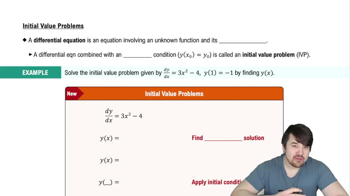
Differential Equations and Initial Value Problems

A differential equation relates a function with its derivatives, describing how the function changes over time. An initial value problem specifies the value of the function at a starting point, allowing for a unique solution. Solving such problems involves finding a function that satisfies both the differential equation and the initial condition.
Video consigliato:
Percorso guidato
05:03
Initial Value Problems

Gompertz Growth Model

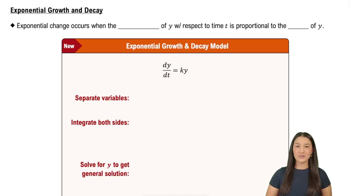
The Gompertz growth model describes growth processes that slow down as they approach a limiting value, often used in biology for tumor growth. It is characterized by a differential equation where the growth rate decreases logarithmically as the mass approaches a carrying capacity K. This model captures realistic saturation effects in growth.
Video consigliato:
09:29
Exponential Growth & Decay

Graphing Solutions of Differential Equations

Graphing the solution of a differential equation involves plotting the function that satisfies the equation over a range of values. This visualizes how the quantity evolves over time, helping to interpret behavior such as growth, decay, or stabilization. Numerical methods or software tools are often used when explicit solutions are complex.
Video consigliato:
04:00
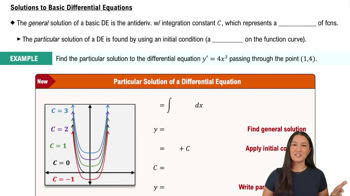
Solutions to Basic Differential Equations
Pratica correlata
Domanda del libro di testo

Explain why or why not Determine whether the following statements are true and give an explanation or counterexample


b. If k>0 and b>0 then y(t)=0 is never a solution of y'(t)=ky−b.

44
views

Domanda del libro di testo

33–36. {Use of Tech} Computing Euler approximations Use a calculator or computer program to carry out the following steps.

b. Using the exact solution (also given), find the error in the approximation to y(T) (only at the right endpoint of the time interval).


y′(t) = t/y, y(0) = 4; Δt = 0.1, T = 2; y(t) = √(t² + 16)

49
views
Domanda del libro di testo

Explain why or why not Determine whether the following statements are true and give an explanation or counterexample.

b. The general solution of the separable equation y'(t) = t/(y' + 10y⁴) can be expressed explicitly with y in terms of t.

48
views
Domanda del libro di testo

23–26. Stirred tank reactions For each of the following stirred tank reactions, carry out the following analysis.

b. Solve the initial value problem.


A 500-L tank is initially filled with pure water. A copper sulfate solution with a concentration of 20 g/L flows into the tank at a rate of 4 L/min. The thoroughly mixed solution is drained from the tank at a rate of 4 L/min.

39
views
Domanda del libro di testo

27–30. Predator-prey models Consider the following pairs of differential equations that model a predator-prey system with populations x and y. In each case, carry out the following steps.

b. Find the lines along which x'(t) = 0. Find the lines along which y'(t) = 0.


x′(t) = 2x − 4xy, y′(t) = −y + 2xy

40
views
Domanda del libro di testo

17–20. Increasing and decreasing solutions Consider the following differential equations. A detailed direction field is not needed.


b. In what regions are solutions increasing? Decreasing?


y'(t) = (y−1)(1+y)

47
views