
Ch. 9 - Differential Equations
Briggs - Calculus: Early Transcendentals 3rd Edition
Briggs3rd EditionCalculus: Early TranscendentalsISBN: 9780136847243Non è quello che usi tu?Cambia libro di testo
Capitolo 9, Problema 9.3.41b

Explain why or why not Determine whether the following statements are true and give an explanation or counterexample.
b. The general solution of the separable equation y'(t) = t/(y' + 10y⁴) can be expressed explicitly with y in terms of t.

Guida verificata passo dopo passo
1
First, carefully examine the given differential equation: \(y'(t) = \frac{t}{y' + 10y^{4}}\). Notice that \(y'\) appears on both sides of the equation, which makes it implicit in \(y'\) rather than explicitly solved for \(y'\).
Rewrite the equation to isolate \(y'\) terms on one side: multiply both sides by \((y' + 10y^{4})\) to get \(y'(y' + 10y^{4}) = t\). This expands to \(y'^2 + 10y^{4}y' = t\).
Recognize that this is a quadratic equation in terms of \(y'\), specifically \(y'^2 + 10y^{4}y' - t = 0\). To find \(y'\), you would use the quadratic formula: \(y' = \frac{-10y^{4} \pm \sqrt{(10y^{4})^{2} + 4t}}{2}\).
Since \(y'\) is expressed in terms of \(y\) and \(t\) but involves a square root, the equation is not separable in the usual sense (i.e., it cannot be written as \(\frac{dy}{dt} = f(t)g(y)\) straightforwardly). This complicates finding an explicit solution for \(y\) in terms of \(t\).
Therefore, because the equation is implicit and involves solving a quadratic in \(y'\), the general solution cannot be expressed explicitly with \(y\) in terms of \(t\) using standard methods for separable equations.

Risposta video verificata per un problema simile:

Questa soluzione video è stata consigliata dai nostri tutor come utile per risolvere questo problema.
Durata del video:
2m

Concetti chiave

Ecco i concetti essenziali che devi comprendere per rispondere correttamente alla domanda.

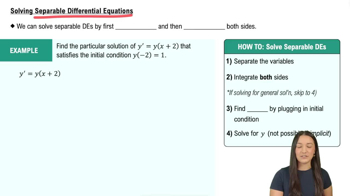
Separable Differential Equations

A separable differential equation can be written as dy/dt = g(t)h(y), allowing the variables to be separated on opposite sides of the equation. This form enables integration of each side independently to find the general solution. Recognizing whether an equation is separable is crucial for solving it explicitly.
Video consigliato:
06:06
Solving Separable Differential Equations

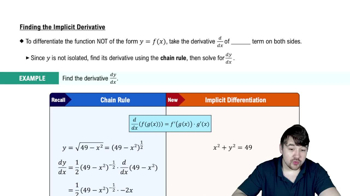
Implicit vs. Explicit Solutions

An explicit solution expresses the dependent variable directly in terms of the independent variable, e.g., y = f(t). An implicit solution relates y and t without isolating y, often requiring further manipulation to solve explicitly. Some differential equations only yield implicit solutions due to their complexity.
Video consigliato:
Percorso guidato
05:14
Finding The Implicit Derivative

Solving Nonlinear Differential Equations

Nonlinear differential equations, especially those involving terms like y⁴ or y', can be challenging to solve explicitly. They may require substitution, numerical methods, or implicit solutions. Understanding the structure of the equation helps determine if an explicit solution is feasible.
Video consigliato:
06:06
Solving Separable Differential Equations
Pratica correlata
Domanda del libro di testo

{Use of Tech} Intravenous drug dosing The amount of drug in the blood of a patient (in milligrams) administered via an intravenous line is governed by the initial value problem y’(t) = -0.02y + 3, y(0) = 0 where t is measured in hours.


b. What is the steady-state level of the drug?

38
views
Domanda del libro di testo

Explain why or why not Determine whether the following statements are true and give an explanation or counterexample


b. If k>0 and b>0 then y(t)=0 is never a solution of y'(t)=ky−b.

44
views
Domanda del libro di testo

33–36. {Use of Tech} Computing Euler approximations Use a calculator or computer program to carry out the following steps.

b. Using the exact solution (also given), find the error in the approximation to y(T) (only at the right endpoint of the time interval).


y′(t) = t/y, y(0) = 4; Δt = 0.1, T = 2; y(t) = √(t² + 16)

49
views
Domanda del libro di testo

52-56. In this section, several models are presented and the solution of the associated differential equation is given. Later in the chapter, we present methods for solving these differential equations.


{Use of Tech} Tumor growth The growth of cancer tumors may be modeled by the Gompertz growth equation. Let M(t) be the mass of a tumor, for t ≥ 0. The relevant initial value problem is:


dM/dt = -rM(t)ln(M(t)/K), M(0) = M₀,


where r and K are positive constants and 0 < M₀ < K.


b. Graph the solution for M₀ = 100 and r = 0.05.

25
views
Domanda del libro di testo

23–26. Stirred tank reactions For each of the following stirred tank reactions, carry out the following analysis.

b. Solve the initial value problem.


A 500-L tank is initially filled with pure water. A copper sulfate solution with a concentration of 20 g/L flows into the tank at a rate of 4 L/min. The thoroughly mixed solution is drained from the tank at a rate of 4 L/min.

39
views
Domanda del libro di testo

27–30. Predator-prey models Consider the following pairs of differential equations that model a predator-prey system with populations x and y. In each case, carry out the following steps.

b. Find the lines along which x'(t) = 0. Find the lines along which y'(t) = 0.


x′(t) = 2x − 4xy, y′(t) = −y + 2xy

40
views