
Ch. 9 - Differential Equations
Briggs - Calculus: Early Transcendentals 3rd Edition
Briggs3rd EditionCalculus: Early TranscendentalsISBN: 9780136847243Non è quello che usi tu?Cambia libro di testo
Capitolo 9, Problema 9.1.15

7–16. Verifying general solutions Verify that the given function is a solution of the differential equation that follows it. Assume C, C1, C2 and C3 are arbitrary constants.
u(t) = C₁t⁵ + C₂t⁻⁴ - t³; t²u''(t) - 20u(t) = 14t³

Guida verificata passo dopo passo
1
Identify the given function and the differential equation: the function is \(u(t) = C_1 t^5 + C_2 t^{-4} - t^3\), and the differential equation is \(t^2 u''(t) - 20 u(t) = 14 t^3\).
Compute the first derivative \(u'(t)\) by differentiating each term of \(u(t)\) with respect to \(t\): use the power rule for derivatives.
Compute the second derivative \(u''(t)\) by differentiating \(u'(t)\) again with respect to \(t\).
Substitute \(u(t)\) and \(u''(t)\) into the left-hand side of the differential equation: calculate \(t^2 u''(t) - 20 u(t)\).
Simplify the expression obtained after substitution and verify if it equals the right-hand side \$14 t^3$ for all $t$, confirming that $u(t)$ is a solution.

Risposta video verificata per un problema simile:

Questa soluzione video è stata consigliata dai nostri tutor come utile per risolvere questo problema.
Durata del video:
5m

Concetti chiave

Ecco i concetti essenziali che devi comprendere per rispondere correttamente alla domanda.

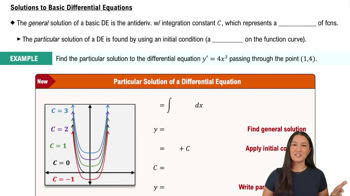
General Solution of Differential Equations

A general solution includes arbitrary constants representing all possible solutions to a differential equation. Verifying a solution involves substituting it into the equation to check if it satisfies the relationship for all values in the domain.
Video consigliato:
04:00
Solutions to Basic Differential Equations

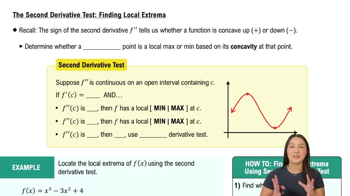
Second Derivative and Differentiation

The second derivative measures the rate of change of the first derivative and is essential in second-order differential equations. Calculating u''(t) accurately is crucial for substituting into the given differential equation.
Video consigliato:
06:02
The Second Derivative Test: Finding Local Extrema

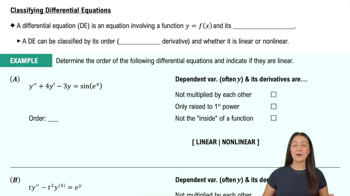
Substitution and Simplification in Differential Equations

To verify a solution, substitute the function and its derivatives into the differential equation. Simplify the resulting expression to confirm if both sides of the equation are equal, ensuring the function satisfies the equation.
Video consigliato:
07:39
Classifying Differential Equations
Pratica correlata
Domanda del libro di testo

12–16. Sketching direction fields Use the window [-2, 2] x [-2, 2] to sketch a direction field for the following equations. Then sketch the solution curve that corresponds to the given initial condition. A detailed direction field is not needed.

y(x) = sin y, y(−2) = 1/2

59
views
Domanda del libro di testo

Logistic growth in India The population of India was 435 million in 1960 (t=0) and 487 million in 1965 (t=5). The projected population for 2050 is 1.57 billion.

e. Discuss some possible shortcomings of this model. Why might the carrying capacity be either greater than or less than the value predicted by the model?

61
views
Domanda del libro di testo

Direction fields Consider the direction field for the equation y′=y(2−y) shown in the figure and initial conditions of the form y(0)=A.

d. For what values of A are the corresponding solutions decreasing, for t≥0

71
views
Domanda del libro di testo

11–18. Solving initial value problems Use the method of your choice to find the solution of the following initial value problems.

y′(t) = -3y + 9, y(0) = 4

98
views
Domanda del libro di testo

What are the assumptions underlying the predator-prey model discussed in this section?

96
views
Domanda del libro di testo

39–42. Special equations A special class of first-order linear equations have the form a(t)y'(t)+a'(t)y(t)=f(t), where a and f are given functions of t. Notice that the left side of this equation can be written as the derivative of a product, so the equation has the form

a(t)y'(t) + a'(t)y(t) = d/dt (a(t)y(t)) = f(t). 

Therefore, the equation can be solved by integrating both sides with respect to t. Use this idea to solve the following initial value problems. 


t³y′(t) + 3t²y = (1 + t)/t, y(1) = 6

71
views