Ch. 9 - Differential Equations
Briggs - Calculus: Early Transcendentals 3rd Edition
Briggs3rd EditionCalculus: Early TranscendentalsISBN: 9780136847243Non è quello che usi tu?Cambia libro di testo
Capitolo 9, Problema 9.R.28e

Logistic growth in India The population of India was 435 million in 1960 (t=0) and 487 million in 1965 (t=5). The projected population for 2050 is 1.57 billion.
e. Discuss some possible shortcomings of this model. Why might the carrying capacity be either greater than or less than the value predicted by the model?

Guida verificata passo dopo passo
1
Understand that the logistic growth model assumes a fixed carrying capacity, which is the maximum population the environment can sustain indefinitely.
Recognize that the carrying capacity predicted by the model is based on current assumptions about resources, technology, and environmental conditions, which can change over time.
Consider that the carrying capacity might be greater than predicted if technological advances improve resource availability or if policies enhance sustainability.
Consider that the carrying capacity might be less than predicted if environmental degradation, resource depletion, or unforeseen social factors reduce the ability to support the population.
Acknowledge that the logistic model simplifies complex population dynamics and may not account for sudden changes, migration, or other demographic factors, which are potential shortcomings of the model.

Risposta video verificata per un problema simile:

Questa soluzione video è stata consigliata dai nostri tutor come utile per risolvere questo problema.
Durata del video:
1m

Concetti chiave

Ecco i concetti essenziali che devi comprendere per rispondere correttamente alla domanda.

Logistic Growth Model

The logistic growth model describes population growth that starts exponentially but slows as it approaches a maximum limit called the carrying capacity. It is represented by an S-shaped curve, reflecting limited resources and environmental constraints that prevent indefinite growth.
Video consigliato:
09:29
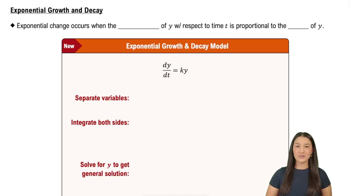
Exponential Growth & Decay

Carrying Capacity

Carrying capacity is the maximum population size that an environment can sustain indefinitely given available resources, space, and other ecological factors. It is not fixed and can change due to technological, environmental, or social factors affecting resource availability.
Video consigliato:
07:39
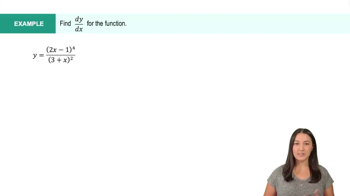
Intro to the Chain Rule Example 2

Model Limitations and Assumptions

Mathematical models like logistic growth rely on assumptions such as constant carrying capacity and uniform resource distribution. Real-world factors like migration, policy changes, technological advances, and environmental shifts can cause deviations, making predictions uncertain or inaccurate.
Video consigliato:
05:50
One-Sided Limits