
Ch. 9 - Differential Equations
Briggs - Calculus: Early Transcendentals 3rd Edition
Briggs3rd EditionCalculus: Early TranscendentalsISBN: 9780136847243Non è quello che usi tu?Cambia libro di testo
Capitolo 9, Problema 9.R.26a

Logistic growth The population of a rabbit community is governed by the initial value problem
P′(t) = 0.2 P (1 − P/1200), P(0) = 50
a. Find the equilibrium solutions.

Guida verificata passo dopo passo
1
Identify the differential equation given: \(P\'(t) = 0.2 P \left(1 - \frac{P}{1200}\right)\).
Recall that equilibrium solutions occur when the population does not change over time, meaning \(P\'(t) = 0\).
Set the right-hand side of the differential equation equal to zero: \(0.2 P \left(1 - \frac{P}{1200}\right) = 0\).
Solve the equation \(0.2 P \left(1 - \frac{P}{1200}\right) = 0\) by setting each factor equal to zero separately: \(P = 0\) or \(1 - \frac{P}{1200} = 0\).
From \(1 - \frac{P}{1200} = 0\), solve for \(P\) to find the second equilibrium solution: \(P = 1200\).

Risposta video verificata per un problema simile:

Questa soluzione video è stata consigliata dai nostri tutor come utile per risolvere questo problema.
Durata del video:
1m

Concetti chiave

Ecco i concetti essenziali che devi comprendere per rispondere correttamente alla domanda.

Logistic Growth Model

The logistic growth model describes population growth that starts exponentially but slows as the population approaches a carrying capacity. It is represented by the differential equation P'(t) = rP(1 - P/K), where r is the growth rate and K is the carrying capacity. This model reflects limited resources affecting growth.
Video consigliato:
09:29
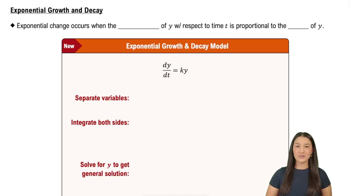
Exponential Growth & Decay

Equilibrium Solutions of Differential Equations

Equilibrium solutions occur when the rate of change is zero, meaning P'(t) = 0. For population models, these solutions represent steady states where the population remains constant over time. Finding equilibria involves setting the differential equation's right side to zero and solving for P.
Video consigliato:
04:00
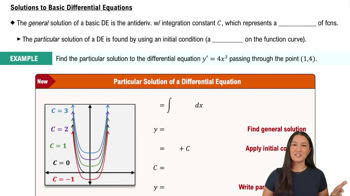
Solutions to Basic Differential Equations

Initial Value Problem (IVP)

An initial value problem specifies a differential equation along with an initial condition, such as P(0) = 50. This condition helps determine a unique solution curve from the family of possible solutions. Understanding IVPs is essential for applying and interpreting models in real-world contexts.
Video consigliato:
Percorso guidato
05:03
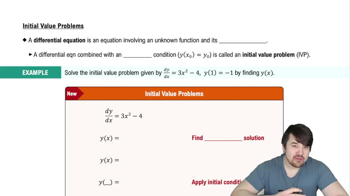
Initial Value Problems