
Ch.12 - Parametric and Polar Curves
Briggs - Calculus: Early Transcendentals 3rd Edition
Briggs3rd EditionCalculus: Early TranscendentalsISBN: 9780136847243Non è quello che usi tu?Cambia libro di testo
Capitolo 12, Problema 12.3.25

25–28. Horizontal and vertical tangents Find the points at which the following polar curves have horizontal or vertical tangent lines.
r = 4 cos θ

Guida verificata passo dopo passo
1
Recall that for a polar curve given by \(r = f(\theta)\), the Cartesian coordinates are \(x = r \cos \theta\) and \(y = r \sin \theta\).
To find the slope of the tangent line, compute \(\frac{dy}{dx} = \frac{\frac{dy}{d\theta}}{\frac{dx}{d\theta}}\). This requires finding \(\frac{dx}{d\theta}\) and \(\frac{dy}{d\theta}\) using the product and chain rules.
Calculate \(\frac{dx}{d\theta} = \frac{d}{d\theta} (r \cos \theta) = \frac{dr}{d\theta} \cos \theta - r \sin \theta\) and \(\frac{dy}{d\theta} = \frac{d}{d\theta} (r \sin \theta) = \frac{dr}{d\theta} \sin \theta + r \cos \theta\).
Find \(\frac{dr}{d\theta}\) by differentiating \(r = 4 \cos \theta\), so \(\frac{dr}{d\theta} = -4 \sin \theta\).
Set the numerator of \(\frac{dy}{dx}\) equal to zero to find horizontal tangents (where \(\frac{dy}{d\theta} = 0\) and \(\frac{dx}{d\theta} \neq 0\)), and set the denominator equal to zero to find vertical tangents (where \(\frac{dx}{d\theta} = 0\) and \(\frac{dy}{d\theta} \neq 0\)). Solve these equations for \(\theta\) and then find the corresponding points \((r, \theta)\).

Risposta video verificata per un problema simile:

Questa soluzione video è stata consigliata dai nostri tutor come utile per risolvere questo problema.
Durata del video:
9m

Concetti chiave

Ecco i concetti essenziali che devi comprendere per rispondere correttamente alla domanda.

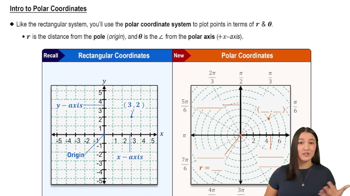
Polar Coordinates and Polar Curves

Polar coordinates represent points using a radius and an angle (r, θ) instead of Cartesian coordinates (x, y). Polar curves are equations expressed in terms of r and θ, describing shapes based on the distance from the origin and the angle. Understanding how to interpret and plot these curves is essential for analyzing their properties.
Video consigliato:
05:32
Intro to Polar Coordinates

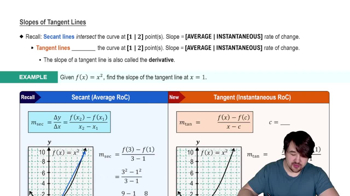
Derivatives of Polar Curves and Tangent Lines

To find tangent lines to polar curves, we convert the polar equation to parametric form (x = r cos θ, y = r sin θ) and compute dy/dx using derivatives with respect to θ. The slope of the tangent line is given by (dy/dθ) / (dx/dθ). This derivative helps identify where the tangent is horizontal or vertical.
Video consigliato:
Percorso guidato
05:13
Slopes of Tangent Lines

Conditions for Horizontal and Vertical Tangents

A horizontal tangent occurs where the slope dy/dx = 0, meaning dy/dθ = 0 while dx/dθ ≠ 0. A vertical tangent occurs where the slope is undefined, meaning dx/dθ = 0 while dy/dθ ≠ 0. Applying these conditions to the derivatives of the polar curve reveals the points with horizontal or vertical tangents.
Video consigliato:
Percorso guidato
5:28
Horizontal Parabolas