

Ch.12 - Parametric and Polar Curves
Briggs - Calculus: Early Transcendentals 3rd Edition
Briggs3rd EditionCalculus: Early TranscendentalsISBN: 9780136847243Non è quello che usi tu?Cambia libro di testo
Capitolo 12, Problema 12.2.30

25–30. Converting coordinates Express the following polar coordinates in Cartesian coordinates.


(4, 5π)

Guida verificata passo dopo passo
1
Recall the formulas to convert polar coordinates \((r, \theta)\) to Cartesian coordinates \((x, y)\): \(x = r \cos(\theta)\) \(y = r \sin(\theta)\)
Identify the given polar coordinates: \(r = 4\) and \(\theta = 5\pi\).
Substitute the values into the conversion formulas: \(x = 4 \cos(5\pi)\) \(y = 4 \sin(5\pi)\)
Use the periodic properties of trigonometric functions to simplify \(\cos(5\pi)\) and \(\sin(5\pi)\). Remember that \(\cos(\theta)\) and \(\sin(\theta)\) have periods of \(2\pi\).
Calculate the simplified values of \(x\) and \(y\) to express the Cartesian coordinates corresponding to the given polar coordinates.

Risposta video verificata per un problema simile:

Questa soluzione video è stata consigliata dai nostri tutor come utile per risolvere questo problema.
Durata del video:
2m

Concetti chiave

Ecco i concetti essenziali che devi comprendere per rispondere correttamente alla domanda.

Polar Coordinates

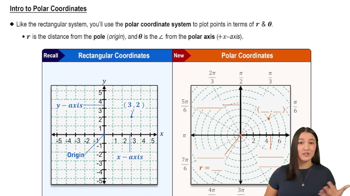
Polar coordinates represent a point in the plane using a radius and an angle, denoted as (r, θ), where r is the distance from the origin and θ is the angle measured from the positive x-axis. Understanding this system is essential for converting to Cartesian coordinates.
Video consigliato:
05:32
Intro to Polar Coordinates

Conversion Formulas from Polar to Cartesian

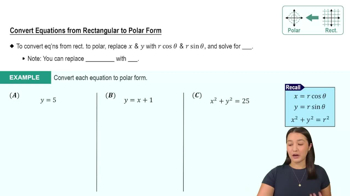
To convert polar coordinates (r, θ) to Cartesian coordinates (x, y), use the formulas x = r cos(θ) and y = r sin(θ). These formulas translate the radius and angle into horizontal and vertical distances on the Cartesian plane.
Video consigliato:
3:37
Convert Equations from Rectangular to Polar

Angle Measurement and Trigonometric Values

Angles in polar coordinates are often given in radians. Knowing how to evaluate trigonometric functions like sine and cosine at specific angles, such as multiples of π, is crucial for accurate conversion to Cartesian coordinates.
Video consigliato:
Percorso guidato
6:04
Introduction to Trigonometric Functions
Pratica correlata
Domanda del libro di testo

57–62. Polar equations for conic sections Graph the following conic sections, labeling the vertices, foci, directrices, and asymptotes (if they exist). Use a graphing utility to check your work.


r = 1/(2 - 2 sin θ)

23
views
Domanda del libro di testo

39–50. Equations of ellipses and hyperbolas Find an equation of the following ellipses and hyperbolas, assuming the center is at the origin. 


A hyperbola with vertices (±4, 0) and foci (±6, 0)

60
views
Domanda del libro di testo

Second derivative Assume a curve is given by the parametric equations x=f(t) and y=g(t), where f and g are twice differentiable. Use the Chain Rule to show that y″x=(fʹ(t)g″(t)−gʹ(t)f″(t))/(fʹ(t))³.  

43
views
Domanda del libro di testo

57–64. Graphing polar curves Graph the following equations. Use a graphing utility to check your work and produce a final graph.


r² = 4 sin θ  

54
views
Domanda del libro di testo

Air drop—inverse problem A plane traveling horizontally at 100 m/s over flat ground at an elevation of 4000 m must drop an emergency packet on a target on the ground. The trajectory of the packet is given by

x = 100t, y = −4.9t² + 4000, t ≥ 0

where the origin is the point on the ground directly beneath the plane at the moment of the release. How many horizontal meters before the target should the packet be released in order to hit the target?

47
views
Domanda del libro di testo

63–74. Arc length of polar curves Find the length of the following polar curves.


{Use of Tech} The complete limaçon r=4−2cosθ

24
views