
Ch.12 - Parametric and Polar Curves
Briggs - Calculus: Early Transcendentals 3rd Edition
Briggs3rd EditionCalculus: Early TranscendentalsISBN: 9780136847243Non è quello che usi tu?Cambia libro di testo
Capitolo 12, Problema 12.1.114

Second derivative Assume a curve is given by the parametric equations x=f(t) and y=g(t), where f and g are twice differentiable. Use the Chain Rule to show that y″x=(fʹ(t)g″(t)−gʹ(t)f″(t))/(fʹ(t))³.  

Guida verificata passo dopo passo
1
Recall that for parametric equations \(x = f(t)\) and \(y = g(t)\), the first derivative of \(y\) with respect to \(x\) is given by the chain rule as \(\frac{dy}{dx} = \frac{\frac{dy}{dt}}{\frac{dx}{dt}} = \frac{g'(t)}{f'(t)}\).
To find the second derivative \(\frac{d^2y}{dx^2}\), we differentiate \(\frac{dy}{dx}\) with respect to \(x\). Using the chain rule, this is \(\frac{d}{dx} \left( \frac{dy}{dx} \right) = \frac{d}{dt} \left( \frac{g'(t)}{f'(t)} \right) \cdot \frac{dt}{dx}\).
Calculate \(\frac{d}{dt} \left( \frac{g'(t)}{f'(t)} \right)\) using the quotient rule: \(\frac{d}{dt} \left( \frac{g'(t)}{f'(t)} \right) = \frac{g''(t) f'(t) - g'(t) f''(t)}{(f'(t))^2}\).
Since \(\frac{dt}{dx} = \frac{1}{\frac{dx}{dt}} = \frac{1}{f'(t)}\), substitute this into the expression for the second derivative to get \(\frac{d^2y}{dx^2} = \frac{g''(t) f'(t) - g'(t) f''(t)}{(f'(t))^2} \cdot \frac{1}{f'(t)}\).
Simplify the expression to obtain \(\frac{d^2y}{dx^2} = \frac{f'(t) g''(t) - g'(t) f''(t)}{(f'(t))^3}\), which is the desired formula.

Risposta video verificata per un problema simile:

Questa soluzione video è stata consigliata dai nostri tutor come utile per risolvere questo problema.
Durata del video:
3m

Concetti chiave

Ecco i concetti essenziali che devi comprendere per rispondere correttamente alla domanda.

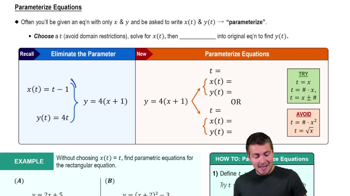
Parametric Equations and Derivatives

Parametric equations express coordinates as functions of a parameter, typically t. To analyze curves defined parametrically, derivatives of x and y with respect to t are used. Understanding how to compute first and second derivatives of these functions is essential for studying the curve's behavior.
Video consigliato:
08:02
Parameterizing Equations

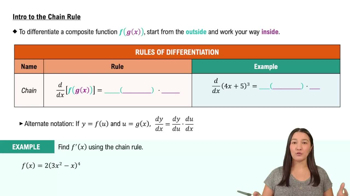
Chain Rule in Differentiation

The Chain Rule allows differentiation of composite functions by relating the derivative of the outer function to the derivative of the inner function. In parametric contexts, it helps find derivatives of y with respect to x by linking dy/dt and dx/dt, crucial for expressing higher-order derivatives like y''.
Video consigliato:
05:02
Intro to the Chain Rule

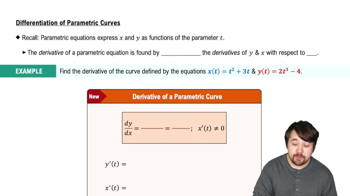
Second Derivative of Parametric Curves

The second derivative y'' with respect to x measures the curvature of a parametric curve. It is found by differentiating dy/dx with respect to x, often using the chain rule to convert derivatives with respect to t into derivatives with respect to x. The formula involves first and second derivatives of both x and y with respect to t.
Video consigliato:
Percorso guidato
06:49
Differentiation of Parametric Curves