Ch.12 - Parametric and Polar Curves
Briggs - Calculus: Early Transcendentals 3rd Edition
Briggs3rd EditionCalculus: Early TranscendentalsISBN: 9780136847243Non è quello che usi tu?Cambia libro di testo
Capitolo 12, Problema 12.2.43

37–48. Polar-to-Cartesian coordinates Convert the following equations to Cartesian coordinates. Describe the resulting curve.


r = 6 cos θ + 8 sin θ

Guida verificata passo dopo passo
1
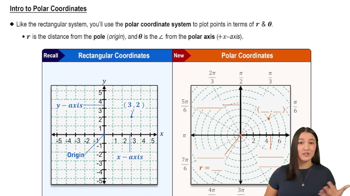
Recall the relationships between polar and Cartesian coordinates: \(x = r \cos \theta\) and \(y = r \sin \theta\). Also, \(r^2 = x^2 + y^2\).
Start with the given polar equation: \(r = 6 \cos \theta + 8 \sin \theta\).
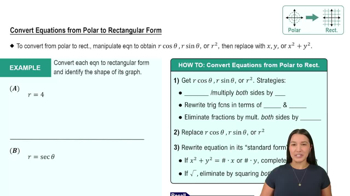
Multiply both sides of the equation by \(r\) to eliminate the denominator when substituting: \(r \cdot r = r (6 \cos \theta + 8 \sin \theta)\), which gives \(r^2 = 6r \cos \theta + 8r \sin \theta\).
Substitute \(r^2\) with \(x^2 + y^2\), \(r \cos \theta\) with \(x\), and \(r \sin \theta\) with \(y\) to get: \(x^2 + y^2 = 6x + 8y\).
Rewrite the equation to standard form by bringing all terms to one side: \(x^2 - 6x + y^2 - 8y = 0\). Then, complete the square for both \(x\) and \(y\) terms to identify the type and properties of the curve.

Risposta video verificata per un problema simile:

Questa soluzione video è stata consigliata dai nostri tutor come utile per risolvere questo problema.
Durata del video:
4m

Concetti chiave

Ecco i concetti essenziali che devi comprendere per rispondere correttamente alla domanda.

Polar and Cartesian Coordinate Systems

Polar coordinates represent points using a radius and an angle (r, θ), while Cartesian coordinates use (x, y) positions on a plane. Understanding how to convert between these systems is essential for analyzing curves defined in polar form.
Video consigliato:
05:32
Intro to Polar Coordinates

Conversion Formulas Between Polar and Cartesian Coordinates

The key formulas for conversion are x = r cos θ and y = r sin θ. Additionally, r² = x² + y² and tan θ = y/x. These relationships allow rewriting polar equations in terms of x and y to identify the curve in Cartesian form.
Video consigliato:
05:32
Intro to Polar Coordinates

Identifying and Describing Curves from Equations

After converting to Cartesian form, recognizing the type of curve (e.g., circle, ellipse, line) involves rearranging the equation and comparing it to standard forms. This helps in describing the geometric shape represented by the original polar equation.
Video consigliato:
6:50
Convert Equations from Polar to Rectangular