Ch.12 - Parametric and Polar Curves
Briggs - Calculus: Early Transcendentals 3rd Edition
Briggs3rd EditionCalculus: Early TranscendentalsISBN: 9780136847243Non è quello che usi tu?Cambia libro di testo
Capitolo 12, Problema 12.1.55

53–56. Circular motion Find parametric equations that describe the circular path of the following objects. For Exercises 53–55, assume (x, y) denotes the position of the object relative to the origin at the center of the circle. Use the units of time specified in the problem. There are many ways to describe any circle.


A bicyclist rides counterclockwise with constant speed around a circular velodrome track with a radius of 50 m, completing one lap in 24 seconds.

Guida verificata passo dopo passo
1
Identify the key parameters of the circular motion: the radius \(r = 50\) meters, and the period \(T = 24\) seconds, which is the time to complete one full lap around the circle.
Recall that the parametric equations for circular motion centered at the origin with radius \(r\) and angular position \(\theta(t)\) are given by: \(x(t) = r \cos(\theta(t))\), \(y(t) = r \sin(\theta(t))\).
Determine the angular velocity \(\omega\), which is the rate of change of the angle with respect to time. Since one full lap corresponds to an angle of \(2\pi\) radians completed in \(T\) seconds, calculate \(\omega = \frac{2\pi}{T} = \frac{2\pi}{24}\) radians per second.
Express the angle \(\theta(t)\) as a function of time using the angular velocity: \(\theta(t) = \omega t = \frac{2\pi}{24} t\).
Write the final parametric equations for the bicyclist's position as functions of time: \(x(t) = 50 \cos\left(\frac{2\pi}{24} t\right)\), \(y(t) = 50 \sin\left(\frac{2\pi}{24} t\right)\).

Risposta video verificata per un problema simile:

Questa soluzione video è stata consigliata dai nostri tutor come utile per risolvere questo problema.
Durata del video:
3m

Concetti chiave

Ecco i concetti essenziali che devi comprendere per rispondere correttamente alla domanda.

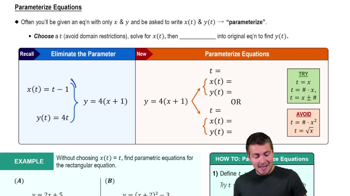
Parametric Equations of Circular Motion

Parametric equations express the coordinates of a point on a circle as functions of time, typically using sine and cosine functions. For a circle of radius r centered at the origin, the position (x, y) can be described as x = r cos(θ(t)) and y = r sin(θ(t)), where θ(t) is the angle parameter changing over time.
Video consigliato:
08:02
Parameterizing Equations

Angular Velocity and Period

Angular velocity (ω) measures how fast an object rotates around a circle, defined as the angle covered per unit time. It relates to the period (T), the time for one full revolution, by ω = 2π / T. Knowing the period allows calculation of ω, which is essential for defining θ(t) = ωt in parametric equations.
Video consigliato:
Percorso guidato
06:29
Derivatives Applied To Velocity

Direction of Motion and Orientation

The direction of motion (clockwise or counterclockwise) affects the sign and form of the parametric equations. Counterclockwise motion is typically represented by increasing θ(t) over time, using positive angular velocity, ensuring the sine and cosine functions trace the circle in the correct orientation.
Video consigliato:
05:21
Finding Limits by Direct Substitution