
Ch.12 - Parametric and Polar Curves
Briggs - Calculus: Early Transcendentals 3rd Edition
Briggs3rd EditionCalculus: Early TranscendentalsISBN: 9780136847243Non è quello che usi tu?Cambia libro di testo
Capitolo 12, Problema 12.1.69a

67–72. Derivatives Consider the following parametric curves.
a. Determine dy/dx in terms of t and evaluate it at the given value of t.


x = cos t, y = 8 sin t; t = π/2

Guida verificata passo dopo passo
1
Recall that for parametric curves defined by \(x = x(t)\) and \(y = y(t)\), the derivative \(\frac{dy}{dx}\) can be found using the chain rule as \(\frac{dy}{dx} = \frac{\frac{dy}{dt}}{\frac{dx}{dt}}\).
Given the parametric equations \(x = \cos t\) and \(y = 8 \sin t\), compute the derivatives with respect to \(t\): \(\frac{dx}{dt} = -\sin t\) and \(\frac{dy}{dt} = 8 \cos t\).
Substitute these derivatives into the formula for \(\frac{dy}{dx}\) to get \(\frac{dy}{dx} = \frac{8 \cos t}{-\sin t} = -8 \frac{\cos t}{\sin t}\).
Evaluate \(\frac{dy}{dx}\) at the given value \(t = \frac{\pi}{2}\) by substituting \(t\) into the expression \(-8 \frac{\cos t}{\sin t}\).
Simplify the expression after substitution to find the slope of the curve at \(t = \frac{\pi}{2}\).

Risposta video verificata per un problema simile:

Questa soluzione video è stata consigliata dai nostri tutor come utile per risolvere questo problema.
Durata del video:
2m

Concetti chiave

Ecco i concetti essenziali che devi comprendere per rispondere correttamente alla domanda.

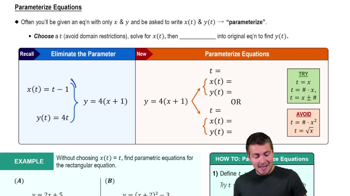
Parametric Equations

Parametric equations express the coordinates of points on a curve as functions of a parameter, often denoted as t. Instead of y as a function of x, both x and y depend on t, allowing the description of more complex curves. Understanding how to work with these equations is essential for analyzing motion and curves in calculus.
Video consigliato:
08:02
Parameterizing Equations

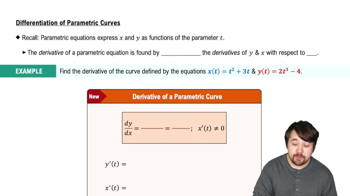
Derivative of Parametric Curves (dy/dx)

For parametric curves, the derivative dy/dx is found by dividing the derivative of y with respect to t by the derivative of x with respect to t, i.e., (dy/dt) / (dx/dt). This method allows us to find the slope of the tangent line to the curve at a specific parameter value, even when y is not explicitly given as a function of x.
Video consigliato:
Percorso guidato
06:49
Differentiation of Parametric Curves

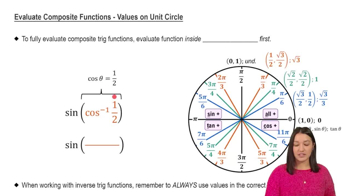
Evaluating Derivatives at Specific Parameter Values

After finding the general expression for dy/dx in terms of t, evaluating it at a specific value of t gives the slope of the tangent line at that point on the curve. This step involves substituting the given t-value into the derivative expressions and simplifying to find the numerical slope.
Video consigliato:
5:10
Evaluate Composite Functions - Values on Unit Circle
Pratica correlata
Domanda del libro di testo

11–14. Working with parametric equations Consider the following parametric equations.

a. Make a brief table of values of t, x, and y.

b. Plot the (x, y) pairs in the table and the complete parametric curve, indicating the positive orientation (the direction of increasing t).


x=2 t,y=3t−4;−10≤d≤10 

52
views
Domanda del libro di testo

Reflection property of parabolas: Consider the parabola y = x²/(4p) with its focus at F(0, p). The goal is to show that the angle of incidence (α) equals the angle of reflection (β).

a. Let P(x₀, y₀) be a point on the parabola. Show that the slope of the tangent line at P is tan θ = x₀/(2p).

296
views
Domanda del libro di testo

Cartesian conversion Write the equation x=y ² in polar coordinates and state values of θ that produce the entire graph of the parabola.

83
views
Domanda del libro di testo

14–18. Parametric descriptions Write parametric equations for the following curves. Solutions are not unique.

The segment of the curve x=y ³ +y+1 that starts at (1, 0) and ends at (11, 2).

63
views
Domanda del libro di testo

Eliminate the parameter in the parametric equations x=1+sin t, y=3+2 sin t, for 0≤t≤π/2, and describe the curve, indicating its positive orientation. How does this curve differ from the curve x=1+sin t, y=3+2 sin t, for π/2≤t≤π?

64
views
Domanda del libro di testo

(Use of Tech) Finger curves: r = f(θ) = cos(aᶿ) - 1.5, where a = (1 + 12π)^(1/(2π)) ≈ 1.78933

a. Show that f(0) = f(2π) and find the point on the curve that corresponds to θ = 0 and θ = 2π.

54
views