
Ch. 1 - Functions
Hass - Thomas' Calculus 15th Edition
Hass15th EditionThomas' CalculusISBN: 9780137616077Non è quello che usi tu?Cambia libro di testo
Capitolo 1, Problema 1.2.2

Algebraic Combinations


In Exercises 1 and 2, find the domains of f, g, f + g, and f ⋅ g.


f(x) = √(x + 1), g(x) = √(x − 1)

Guida verificata passo dopo passo
1
Step 1: Determine the domain of f(x) = √(x + 1). The expression inside the square root, x + 1, must be greater than or equal to zero for the square root to be defined. Solve the inequality x + 1 ≥ 0 to find the domain of f(x).
Step 2: Determine the domain of g(x) = √(x − 1). Similarly, the expression inside the square root, x − 1, must be greater than or equal to zero. Solve the inequality x − 1 ≥ 0 to find the domain of g(x).
Step 3: Find the domain of the sum f + g. The domain of f + g is the intersection of the domains of f and g, as both functions must be defined for the sum to be defined.
Step 4: Find the domain of the product f ⋅ g. The domain of f ⋅ g is also the intersection of the domains of f and g, since both functions must be defined for the product to be defined.
Step 5: Combine the results from Steps 1 to 4 to express the domains of f, g, f + g, and f ⋅ g in interval notation.

Risposta video verificata per un problema simile:

Questa soluzione video è stata consigliata dai nostri tutor come utile per risolvere questo problema.
Durata del video:
4m

Concetti chiave

Ecco i concetti essenziali che devi comprendere per rispondere correttamente alla domanda.

Domain of a Function

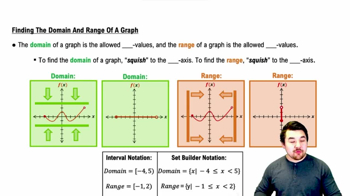
The domain of a function is the set of all possible input values (x-values) for which the function is defined. For functions involving square roots, such as f(x) = √(x + 1) and g(x) = √(x − 1), the expressions under the square roots must be non-negative. This means we need to find the values of x that satisfy these conditions to determine the domain.
Video consigliato:
Percorso guidato
5:10
Finding the Domain and Range of a Graph

Algebraic Combinations of Functions

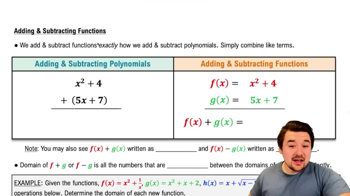
Algebraic combinations of functions involve operations such as addition, subtraction, multiplication, and division applied to two or more functions. In this case, we are looking at f + g and f ⋅ g. The domain of these combinations is determined by the intersection of the individual domains of the functions involved, ensuring that the resulting expressions are defined.
Video consigliato:
Percorso guidato
5:56
Adding & Subtracting Functions

Square Root Function Properties

The square root function has specific properties that affect its domain and range. The output of a square root function is always non-negative, and the input must be greater than or equal to zero. Understanding these properties is crucial for determining the domains of f(x) and g(x), as they dictate the restrictions on x that must be considered when combining these functions.
Video consigliato:
Percorso guidato
06:21
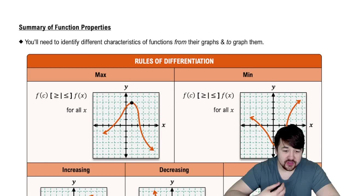
Properties of Functions
Pratica correlata
Domanda del libro di testo

Increasing and Decreasing Functions


Graph the functions in Exercises 37–46. What symmetries, if any, do the graphs have? Specify the intervals over which the function is increasing and the intervals where it is decreasing.


y = −x³

280
views
Domanda del libro di testo

Using the Addition Formulas


Use the addition formulas to derive the identities in Exercises 31–36.


sin (A − B) = sin A cos B − cos A sin B

221
views
Domanda del libro di testo

Increasing and Decreasing Functions


Graph the functions in Exercises 37–46. What symmetries, if any, do the graphs have? Specify the intervals over which the function is increasing and the intervals where it is decreasing.


y = (−x)²/³

188
views
Domanda del libro di testo

[Technology Exercise]


a. Graph the functions f(x) = x/2 and g(x) = 1 + (4/x) together to identify the values of x for which


x/2 > 1 + 4/x


b. Confirm your findings in part (a) algebraically.

177
views
Domanda del libro di testo

Finding a Viewing Window


In Exercises 5–30, find an appropriate graphing software viewing window for the given function and use it to display that function’s graph. The window should give a picture of the overall behavior of the function. There is more than one choice, but incorrect choices can miss important aspects of the function.


y = x + (1/10) sin 30x

184
views
Domanda del libro di testo

Shifting Graphs


Exercises 27–36 tell how many units and in what directions the graphs of the given equations are to be shifted. Give an equation for the shifted graph. Then sketch the original and shifted graphs together, labeling each graph with its equation.


y = x³ Left 1, down 1

177
views