Ch. 1 - Functions
Hass - Thomas' Calculus 15th Edition
Hass15th EditionThomas' CalculusISBN: 9780137616077Non è quello che usi tu?Cambia libro di testo
Capitolo 1, Problema 1.1.37

Increasing and Decreasing Functions


Graph the functions in Exercises 37–46. What symmetries, if any, do the graphs have? Specify the intervals over which the function is increasing and the intervals where it is decreasing.


y = −x³

Guida verificata passo dopo passo
1
First, identify the basic shape of the graph of the function y = -x³. The function y = x³ is a cubic function, which typically has an S-shaped curve. The negative sign in front of x³ indicates that the graph will be reflected over the x-axis, resulting in a flipped S-shape.
Next, determine the symmetry of the function. A function is symmetric about the origin if replacing x with -x results in the negative of the original function. For y = -x³, replacing x with -x gives y = -(-x)³ = -x³, which is the same as the original function. Therefore, the graph is symmetric about the origin.
To find the intervals where the function is increasing or decreasing, calculate the derivative of the function. The derivative of y = -x³ is y' = -3x². This derivative will help us determine the slope of the tangent line at any point on the graph.
Analyze the sign of the derivative y' = -3x². Since x² is always non-negative, -3x² is always non-positive. This means the derivative is always less than or equal to zero, indicating that the function is always decreasing.
Finally, conclude that the function y = -x³ is decreasing on the entire real line, from negative infinity to positive infinity. There are no intervals where the function is increasing.

Risposta video verificata per un problema simile:

Questa soluzione video è stata consigliata dai nostri tutor come utile per risolvere questo problema.
Durata del video:
4m

Concetti chiave

Ecco i concetti essenziali che devi comprendere per rispondere correttamente alla domanda.

Increasing and Decreasing Functions

A function is considered increasing on an interval if, for any two points within that interval, the function's value at the second point is greater than at the first. Conversely, a function is decreasing on an interval if the function's value at the second point is less than at the first. Understanding these concepts is crucial for analyzing the behavior of functions and determining where they rise or fall.
Video consigliato:
07:32
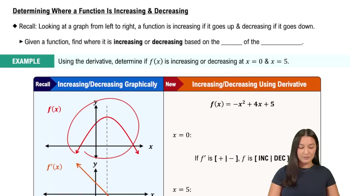
Determining Where a Function is Increasing & Decreasing

Critical Points

Critical points are values of the independent variable where the derivative of a function is either zero or undefined. These points are essential for identifying intervals of increase and decrease, as they often indicate where the function changes from increasing to decreasing or vice versa. Analyzing critical points helps in sketching the graph and understanding the function's overall behavior.
Video consigliato:
04:50
Critical Points

Symmetry in Functions

Symmetry in functions refers to the property where a function exhibits a specific reflective behavior about a line or point. For example, a function is even if it is symmetric about the y-axis, and odd if it is symmetric about the origin. Recognizing these symmetries can simplify the graphing process and provide insights into the function's characteristics.
Video consigliato:
Percorso guidato
06:21
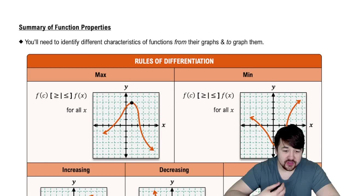
Properties of Functions