Ch. 1 - Functions
Hass - Thomas' Calculus 15th Edition
Hass15th EditionThomas' CalculusISBN: 9780137616077Non è quello che usi tu?Cambia libro di testo
Capitolo 1, Problema 1.2.79b

Combining Functions


Assume that f is an even function, g is an odd function, and both f and g are defined on the entire real line (−∞,∞). Which of the following (where defined) are even? odd?


b. f/g

Guida verificata passo dopo passo
1
First, recall the definitions of even and odd functions. An even function satisfies f(x) = f(-x) for all x, while an odd function satisfies g(x) = -g(-x) for all x.
Consider the function h(x) = f(x)/g(x). To determine if h(x) is even or odd, we need to evaluate h(-x) and compare it to h(x).
Calculate h(-x): h(-x) = f(-x)/g(-x). Since f is even, f(-x) = f(x). Since g is odd, g(-x) = -g(x). Therefore, h(-x) = f(x)/(-g(x)).
Simplify h(-x): h(-x) = -f(x)/g(x). Notice that h(-x) = -h(x), which is the definition of an odd function.
Conclude that the function h(x) = f(x)/g(x) is odd, given that f is even and g is odd.

Risposta video verificata per un problema simile:

Questa soluzione video è stata consigliata dai nostri tutor come utile per risolvere questo problema.
Durata del video:
2m

Concetti chiave

Ecco i concetti essenziali che devi comprendere per rispondere correttamente alla domanda.

Even and Odd Functions

An even function satisfies the property f(-x) = f(x) for all x in its domain, meaning its graph is symmetric about the y-axis. An odd function satisfies g(-x) = -g(x), indicating that its graph is symmetric about the origin. Understanding these definitions is crucial for analyzing the behavior of combined functions.
Video consigliato:
Percorso guidato
06:21
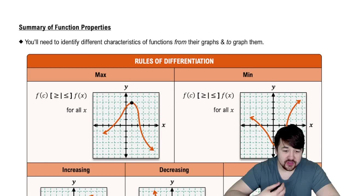
Properties of Functions

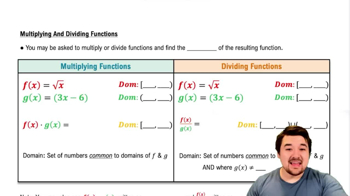
Function Division

When dividing two functions, such as f/g, the resulting function is defined only where g(x) is not zero. The properties of the original functions (even or odd) can influence the nature of the quotient, but one must also consider the points where the denominator may affect the overall function's parity.
Video consigliato:
Percorso guidato
7:24
Multiplying & Dividing Functions

Parity of Combined Functions

The parity of combined functions can be determined by analyzing their definitions. For instance, the quotient f/g will be even if both f and g are even, or if f is even and g is odd. Conversely, it will be odd if f is odd and g is even. This requires careful consideration of the definitions and properties of the functions involved.
Video consigliato:
Percorso guidato
5:56
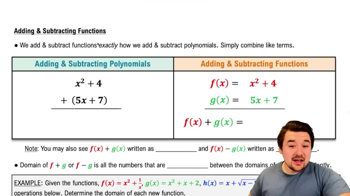
Adding & Subtracting Functions