Ch. 1 - Functions
Hass - Thomas' Calculus 15th Edition
Hass15th EditionThomas' CalculusISBN: 9780137616077Non è quello che usi tu?Cambia libro di testo
Capitolo 1, Problema 39d

Composition of Functions


In Exercises 39 and 40, find


d. (g ○ g) (x).


ƒ(x) = 1/x , g(x) = 1/√ x + 2

Guida verificata passo dopo passo
1
First, understand the composition of functions. The notation (g ○ g)(x) means you need to apply the function g to itself, i.e., g(g(x)).
Start by substituting g(x) into itself. Since g(x) = 1/√(x + 2), replace x in g(x) with g(x) itself.
This substitution gives you g(g(x)) = 1/√(g(x) + 2). Now, substitute g(x) = 1/√(x + 2) into this expression.
You will have g(g(x)) = 1/√((1/√(x + 2)) + 2). Simplify the expression inside the square root.
Finally, simplify the entire expression to find the composition (g ○ g)(x). Remember to handle the square roots and fractions carefully during simplification.

Risposta video verificata per un problema simile:

Questa soluzione video è stata consigliata dai nostri tutor come utile per risolvere questo problema.
Durata del video:
2m

Concetti chiave

Ecco i concetti essenziali che devi comprendere per rispondere correttamente alla domanda.

Function Composition

Function composition involves combining two functions to create a new function. The notation (f ○ g)(x) means applying function g to x first, and then applying function f to the result of g(x). This concept is essential for understanding how to evaluate expressions like (g ○ g)(x), where the function g is applied to itself.
Video consigliato:
3:48
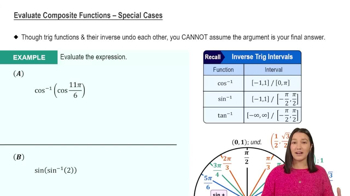
Evaluate Composite Functions - Special Cases

Domain of a Function

The domain of a function is the set of all possible input values (x-values) for which the function is defined. When composing functions, it is crucial to consider the domain of the inner function, as it can affect the overall composition. For example, in g(x) = 1/√(x + 2), the input x must be greater than or equal to -2 to avoid taking the square root of a negative number.
Video consigliato:
Percorso guidato
5:10
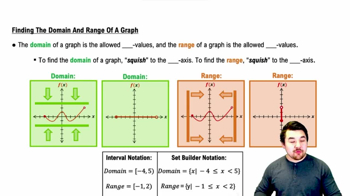
Finding the Domain and Range of a Graph

Evaluating Functions

Evaluating functions involves substituting a specific value into the function's formula to find the corresponding output. In the context of the question, evaluating (g ○ g)(x) requires first calculating g(x) and then substituting that result back into g. This step-by-step evaluation is fundamental for accurately determining the final output of the composed function.
Video consigliato:
Percorso guidato
4:26
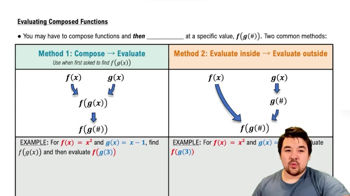
Evaluating Composed Functions