Ch. 1 - Functions
Hass - Thomas' Calculus 15th Edition
Hass15th EditionThomas' CalculusISBN: 9780137616077Non è quello che usi tu?Cambia libro di testo
Capitolo 1, Problema 1.3.46

Evaluate sin (5π/12).

Guida verificata passo dopo passo
1
Recognize that \( \frac{5\pi}{12} \) is not a standard angle for which we know the sine value directly. We can express it as a sum or difference of angles for which we know the sine and cosine values.
Express \( \frac{5\pi}{12} \) as a sum of two angles: \( \frac{5\pi}{12} = \frac{\pi}{3} + \frac{\pi}{4} \). Both \( \frac{\pi}{3} \) and \( \frac{\pi}{4} \) are standard angles.
Use the sine addition formula: \( \sin(a + b) = \sin(a)\cos(b) + \cos(a)\sin(b) \). Here, \( a = \frac{\pi}{3} \) and \( b = \frac{\pi}{4} \).
Substitute the known values: \( \sin(\frac{\pi}{3}) = \frac{\sqrt{3}}{2} \), \( \cos(\frac{\pi}{3}) = \frac{1}{2} \), \( \sin(\frac{\pi}{4}) = \frac{\sqrt{2}}{2} \), and \( \cos(\frac{\pi}{4}) = \frac{\sqrt{2}}{2} \).
Calculate \( \sin(\frac{5\pi}{12}) = \sin(\frac{\pi}{3})\cos(\frac{\pi}{4}) + \cos(\frac{\pi}{3})\sin(\frac{\pi}{4}) \) by substituting the values and simplifying the expression.

Risposta video verificata per un problema simile:

Questa soluzione video è stata consigliata dai nostri tutor come utile per risolvere questo problema.
Durata del video:
5m

Concetti chiave

Ecco i concetti essenziali che devi comprendere per rispondere correttamente alla domanda.

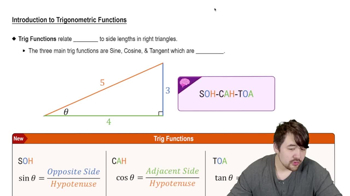
Trigonometric Functions

Trigonometric functions, such as sine, cosine, and tangent, relate angles to ratios of sides in right triangles. The sine function specifically measures the ratio of the length of the opposite side to the hypotenuse in a right triangle. Understanding these functions is essential for evaluating angles and solving problems in trigonometry and calculus.
Video consigliato:
Percorso guidato
6:04
Introduction to Trigonometric Functions

Angle Addition Formulas

The angle addition formulas allow us to express the sine of a sum of angles in terms of the sines and cosines of the individual angles. For example, sin(a + b) = sin(a)cos(b) + cos(a)sin(b). This concept is particularly useful for evaluating sine at angles that are not standard, such as 5π/12, by breaking it down into known angles.
Video consigliato:
Percorso guidato
05:56
Additional Rules for Indefinite Integrals

Unit Circle

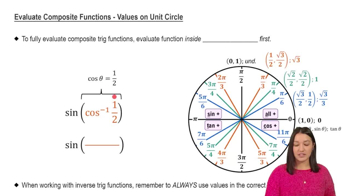
The unit circle is a circle with a radius of one centered at the origin of a coordinate plane. It provides a geometric interpretation of trigonometric functions, where the x-coordinate represents the cosine and the y-coordinate represents the sine of an angle. Understanding the unit circle is crucial for evaluating trigonometric functions at various angles, including those expressed in radians.
Video consigliato:
5:10
Evaluate Composite Functions - Values on Unit Circle