
A pen in the shape of an isosceles right triangle with legs of length x ft and hypotenuse of length h ft is to be built. If fencing costs \$5/ft for the legs and \$10/ft for the hypotenuse, write the total cost C of construction as a function of h.
Ch. 1 - Functions
Capitolo 1, Problema 1.1.3
Functions
In Exercises 1–6, find the domain and range of each function.
F(x) = √(5x + 10)
Guida verificata passo dopo passo1
Step 1: Understand the function F(x) = √(5x + 10). This is a square root function, which means the expression inside the square root must be non-negative for the function to be defined.
Step 2: Set up the inequality for the domain. Since the expression inside the square root must be non-negative, we have 5x + 10 ≥ 0.
Step 3: Solve the inequality 5x + 10 ≥ 0 to find the values of x that satisfy this condition. Subtract 10 from both sides to get 5x ≥ -10.
Step 4: Divide both sides of the inequality by 5 to isolate x, resulting in x ≥ -2. This gives us the domain of the function, which is all x values greater than or equal to -2.
Step 5: Determine the range of the function. Since the square root function outputs non-negative values, the range of F(x) = √(5x + 10) is all non-negative real numbers, starting from 0 and extending to infinity.

Risposta video verificata per un problema simile:
Questa soluzione video è stata consigliata dai nostri tutor come utile per risolvere questo problema.
Durata del video:
3mConcetti chiave
Ecco i concetti essenziali che devi comprendere per rispondere correttamente alla domanda.
Domain of a Function
The domain of a function refers to the set of all possible input values (x-values) for which the function is defined. For the function F(x) = √(5x + 10), the expression under the square root must be non-negative, which imposes restrictions on x. Thus, determining the domain involves solving the inequality 5x + 10 ≥ 0.
Video consigliato:
Percorso guidato
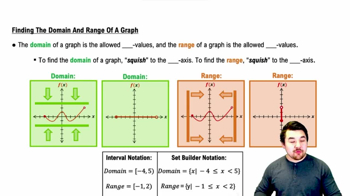
Finding the Domain and Range of a Graph
Range of a Function
The range of a function is the set of all possible output values (y-values) that the function can produce. For F(x) = √(5x + 10), since the square root function only yields non-negative results, the range will start from 0 and extend to positive infinity, depending on the values of x within the domain.
Video consigliato:
Percorso guidato
Finding the Domain and Range of a Graph
Square Root Function
The square root function, denoted as √x, is defined for non-negative values of x and produces non-negative outputs. It is important to understand that the square root function is not defined for negative inputs, which directly influences both the domain and range of functions that include it, such as F(x) = √(5x + 10).
Video consigliato:
Percorso guidato
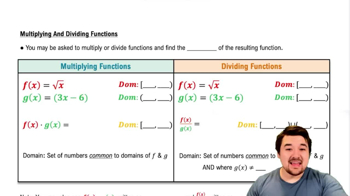
Multiplying & Dividing Functions
Pratica correlata
Domanda del libro di testo
239
views
Domanda del libro di testo
Graphing
In Exercises 69–76, graph each function not by plotting points, but by starting with the graph of one of the standard functions presented in Figures 1.14–1.17 and applying an appropriate transformation.
y = (1/2x) − 1
242
views
Domanda del libro di testo
Evaluate sin (5π/12).
186
views
Domanda del libro di testo
Using the Addition Formulas
Use the addition formulas to derive the identities in Exercises 31–36.
sin (x − π/2) = −cos x
271
views
Domanda del libro di testo
Functions
In Exercises 1–6, find the domain and range of each function.
G(t) = 2/(t² − 16)
494
views
Domanda del libro di testo
In Exercises 5–8, determine whether the graph of the function is symmetric about the 𝔂-axis, the origin, or neither.
𝔂 = x² - 2x - 1
238
views
