Ch. 1 - Functions
Hass - Thomas' Calculus 15th Edition
Hass15th EditionThomas' CalculusISBN: 9780137616077Non è quello che usi tu?Cambia libro di testo
Capitolo 1, Problema 1.2.43

Graph the functions in Exercises 37–56.


y = (x + 1)²/³

Guida verificata passo dopo passo
1
Identify the type of function: The given function is y = (x + 1)^(2/3). This is a power function with a fractional exponent, which indicates a root function.
Determine the domain: Since the base of the power (x + 1) is raised to a fractional power with an even numerator, the expression is defined for all real numbers x. Therefore, the domain is all real numbers.
Find the critical points: To find critical points, take the derivative of the function with respect to x. Use the chain rule to differentiate y = (x + 1)^(2/3).
Analyze the behavior at critical points: Evaluate the derivative to find where it is zero or undefined. These points will help determine local maxima, minima, or points of inflection.
Sketch the graph: Use the information from the derivative and critical points to sketch the graph. Consider the symmetry, intercepts, and end behavior of the function to complete the graph.

Risposta video verificata per un problema simile:

Questa soluzione video è stata consigliata dai nostri tutor come utile per risolvere questo problema.
Durata del video:
4m

Concetti chiave

Ecco i concetti essenziali che devi comprendere per rispondere correttamente alla domanda.

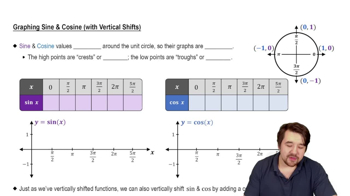
Graphing Functions

Graphing functions involves plotting points on a coordinate plane to visualize the behavior of a function. It requires understanding the function's domain, range, and any transformations applied to the basic function. For y = (x + 1)²/³, identifying key features like intercepts, asymptotes, and symmetry helps in sketching an accurate graph.
Video consigliato:
Percorso guidato
5:53
Graph of Sine and Cosine Function

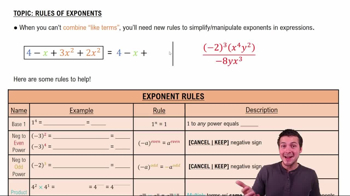
Fractional Exponents

Fractional exponents, such as ²/³, indicate roots and powers. The expression (x + 1)²/³ can be interpreted as the cube root of (x + 1) squared. Understanding fractional exponents is crucial for determining the function's behavior, especially near critical points where the base might be zero or negative.
Video consigliato:
7:39
Introduction to Exponent Rules

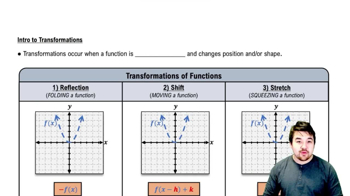
Transformations of Functions

Transformations involve shifting, stretching, or compressing the graph of a function. The expression y = (x + 1)²/³ includes a horizontal shift left by 1 unit due to the (x + 1) term. Recognizing transformations helps in predicting how the graph will move or change shape compared to the parent function y = x²/³.
Video consigliato:
Percorso guidato
5:25
Intro to Transformations