Ch. 10 - Infinite Sequences and Series
Hass - Thomas' Calculus 15th Edition
Hass15th EditionThomas' CalculusISBN: 9780137616077Non è quello che usi tu?Cambia libro di testo
Capitolo 10, Problema 10.4.74b

b. From Example 5, Section 10.2, show that
S = 1 + ∑(from n=1 to ∞) [1 / (n²(n + 1))].

Guida verificata passo dopo passo
1
Recall the series expression from Example 5, Section 10.2, which involves the sum of terms related to \( \frac{1}{n^2 (n+1)} \). Our goal is to express \( S \) as \( 1 + \sum_{n=1}^\infty \frac{1}{n^2 (n+1)} \).
Start by writing the general term of the series: \( \frac{1}{n^2 (n+1)} \). To simplify or analyze this term, consider using partial fraction decomposition to break it into simpler fractions that are easier to sum.
Set up the partial fraction decomposition for \( \frac{1}{n^2 (n+1)} \) as \( \frac{A}{n} + \frac{B}{n^2} + \frac{C}{n+1} \), and solve for constants \( A, B, C \) by multiplying both sides by \( n^2 (n+1) \) and equating coefficients.
Once the partial fractions are found, rewrite the sum \( \sum_{n=1}^\infty \frac{1}{n^2 (n+1)} \) as the sum of simpler series involving \( \sum \frac{1}{n} \), \( \sum \frac{1}{n^2} \), and \( \sum \frac{1}{n+1} \).
Recognize that the term \( 1 \) outside the summation corresponds to the initial term or a boundary condition from the original series, completing the expression \( S = 1 + \sum_{n=1}^\infty \frac{1}{n^2 (n+1)} \).

Risposta video verificata per un problema simile:

Questa soluzione video è stata consigliata dai nostri tutor come utile per risolvere questo problema.
Durata del video:
6m

Concetti chiave

Ecco i concetti essenziali che devi comprendere per rispondere correttamente alla domanda.

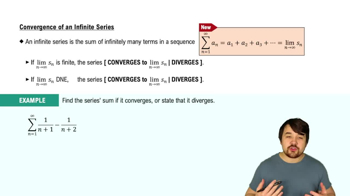
Infinite Series and Summation Notation

An infinite series is the sum of infinitely many terms, often expressed using summation notation (∑). Understanding how to interpret and manipulate these sums is essential for evaluating or transforming series expressions.
Video consigliato:
Percorso guidato
06:52
Convergence of an Infinite Series

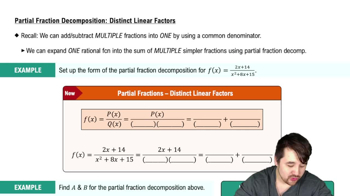
Partial Fraction Decomposition

Partial fraction decomposition breaks a complex rational expression into simpler fractions. This technique is useful for simplifying terms like 1/(n²(n+1)) to facilitate summation or integration.
Video consigliato:
Percorso guidato
10:07
Partial Fraction Decomposition: Distinct Linear Factors

Telescoping Series

A telescoping series is one where many terms cancel out when the series is expanded, leaving only a few terms to sum. Recognizing and applying telescoping can simplify the evaluation of series like the one given.
Video consigliato:
Percorso guidato
06:00
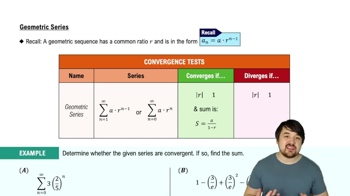
Geometric Series
Pratica correlata
Domanda del libro di testo

∑ (from n=1 to ∞) (1 / √(n + 1)) diverges

b. What should n be in order that the partial sum sₙ = ∑ (from i=1 to n) (1 / √(i + 1)) satisfies sₙ > 1000?

29
views

Domanda del libro di testo

A sequence of rational numbers is described as follows:

1/1,3/2,7/5,17/12,…,a/b,(a + 2b)/(a + b),…

Here the numerators form one sequence, the denominators form a second sequence, and their ratios form a third sequence. Let xₙ and yₙ be, respectively, the numerator and the denominator of the nᵗʰ fraction rₙ = xₙ / yₙ.

b. The fractions rₙ = xₙ / yₙ approach a limit as n increases. What is that limit? (Hint: Use part (a) to show that rₙ² − 2 = ±(1 / yₙ)² and that yₙ is not less than n.)

33
views
Domanda del libro di testo

Intervals of Convergence

In Exercises 1–36, for what values of x does the series converge (b) absolutely?

∑ (from n = 1 to ∞) [ (√(n + 1) − √n)(x − 3)ⁿ ]

23
views
Domanda del libro di testo

Use the Cauchy condensation test from Exercise 59 to show that:

b. ∑ (from n=1 to ∞) [1 / nᵖ] converges if p > 1 and diverges if p ≤ 1.

37
views
Domanda del libro di testo

Intervals of Convergence

Intervals of Convergence

In Exercises 1–36, for what values of x does the series converge (b) absolutely?

∑ (from n = 1 to ∞) [ (3x + 1)^(n + 1) / (2n + 2) ]

29
views
Domanda del libro di testo

Intervals of Convergence

In Exercises 1–36, for what values of x does the series converge (b) absolutely?

∑ (from n = 0 to ∞) [ (−2)ⁿ (n + 1) (x − 1)ⁿ ]

23
views