
Ch. 10 - Infinite Sequences and Series
Hass - Thomas' Calculus 15th Edition
Hass15th EditionThomas' CalculusISBN: 9780137616077Non è quello che usi tu?Cambia libro di testo
Capitolo 10, Problema 10.PE.30

Determining Convergence of Series
Which of the series in Exercises 25–44 converge absolutely, which converge conditionally, and which diverge? Give reasons for your answers.


∑ (from n = 2 to ∞) 1/[n(ln n)²]

Guida verificata passo dopo passo
1
Identify the given series: \( \sum_{n=2}^{\infty} \frac{1}{n (\ln n)^2} \). We want to determine if it converges absolutely, conditionally, or diverges.
Since all terms \( \frac{1}{n (\ln n)^2} \) are positive for \( n \geq 2 \), absolute convergence is equivalent to convergence of the series itself.
Use the Integral Test to analyze convergence because the function \( f(x) = \frac{1}{x (\ln x)^2} \) is positive, continuous, and decreasing for \( x > 1 \).
Set up the integral \( \int_2^{\infty} \frac{1}{x (\ln x)^2} \, dx \). Use the substitution \( t = \ln x \), which implies \( dt = \frac{1}{x} dx \), so the integral becomes \( \int_{\ln 2}^{\infty} \frac{1}{t^2} \, dt \).
Evaluate the integral \( \int_{\ln 2}^{\infty} t^{-2} \, dt \) to determine if it converges. If the integral converges, then by the Integral Test, the series converges absolutely; if it diverges, the series diverges.

Risposta video verificata per un problema simile:

Questa soluzione video è stata consigliata dai nostri tutor come utile per risolvere questo problema.
Durata del video:
5m

Concetti chiave

Ecco i concetti essenziali che devi comprendere per rispondere correttamente alla domanda.

Absolute and Conditional Convergence

A series converges absolutely if the series of absolute values converges. If the original series converges but not absolutely, it is conditionally convergent. Understanding this distinction helps classify the behavior of series involving alternating or positive terms.
Video consigliato:
Percorso guidato
07:51
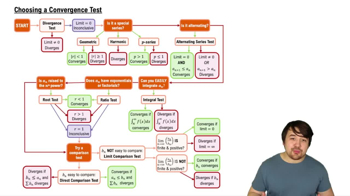
Choosing a Convergence Test

Integral Test for Convergence

The integral test compares a series to an improper integral of a related function. If the integral of f(x) from some point to infinity converges, then the series ∑ f(n) converges. This test is useful for series with terms like 1/[n(ln n)^p].
Video consigliato:
Percorso guidato
07:51
Choosing a Convergence Test

Behavior of Logarithmic Functions in Series

Logarithmic terms in denominators affect convergence rates. For example, series with terms 1/[n(ln n)^p] converge or diverge depending on the exponent p. Recognizing how ln n influences the series is key to applying convergence tests correctly.
Video consigliato:
5:26
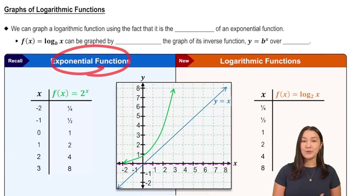
Graphs of Logarithmic Functions