Ch. 10 - Infinite Sequences and Series
Hass - Thomas' Calculus 15th Edition
Hass15th EditionThomas' CalculusISBN: 9780137616077Non è quello che usi tu?Cambia libro di testo
Capitolo 10, Problema 10.2.48

Find the sum of each series in Exercises 45–52.
∑ (from n = 1 to ∞) [ (2n + 1) / (n²(n + 1)²) ]

Guida verificata passo dopo passo
1
Start by examining the general term of the series: \(\frac{2n + 1}{n^{2}(n + 1)^{2}}\). Our goal is to express this term in a form that allows us to use telescoping or known series sums.
Try to decompose the term into partial fractions. Since the denominator is \(n^{2}(n + 1)^{2}\), consider expressing the term as a sum of fractions of the form \(\frac{A}{n} + \frac{B}{n^{2}} + \frac{C}{n + 1} + \frac{D}{(n + 1)^{2}}\).
Set up the equation: \(\frac{2n + 1}{n^{2}(n + 1)^{2}} = \frac{A}{n} + \frac{B}{n^{2}} + \frac{C}{n + 1} + \frac{D}{(n + 1)^{2}}\). Multiply both sides by \(n^{2}(n + 1)^{2}\) to clear denominators and solve for constants \(A\), \(B\), \(C\), and \(D\) by equating coefficients of powers of \(n\).
Once the partial fractions are found, rewrite the series as a sum of simpler series: \(\sum_{n=1}^{\infty} \left( \frac{A}{n} + \frac{B}{n^{2}} + \frac{C}{n + 1} + \frac{D}{(n + 1)^{2}} \right)\). This will allow you to separate the original series into sums that are easier to evaluate or telescope.
Evaluate the sums by recognizing telescoping patterns or using known series results such as the Riemann zeta function for \(\sum \frac{1}{n^{2}}\). Combine the results carefully to find the sum of the original series.

Risposta video verificata per un problema simile:

Questa soluzione video è stata consigliata dai nostri tutor come utile per risolvere questo problema.
Durata del video:
13m

Concetti chiave

Ecco i concetti essenziali che devi comprendere per rispondere correttamente alla domanda.

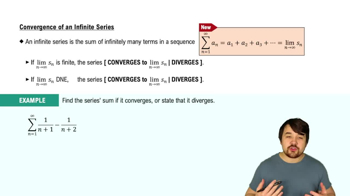
Infinite Series and Convergence

An infinite series is the sum of infinitely many terms. To find its sum, the series must converge, meaning its partial sums approach a finite limit. Understanding convergence tests helps determine if the series sum exists.
Video consigliato:
Percorso guidato
06:52
Convergence of an Infinite Series

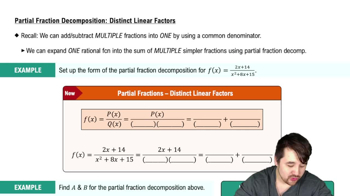
Partial Fraction Decomposition

Partial fraction decomposition breaks a complex rational expression into simpler fractions. This technique simplifies terms in the series, making it easier to identify telescoping patterns or to sum the series explicitly.
Video consigliato:
Percorso guidato
10:07
Partial Fraction Decomposition: Distinct Linear Factors

Telescoping Series

A telescoping series is one where many terms cancel out when the series is expanded. Recognizing this pattern allows simplification of the sum to just a few terms, facilitating the calculation of the infinite sum.
Video consigliato:
Percorso guidato
06:00
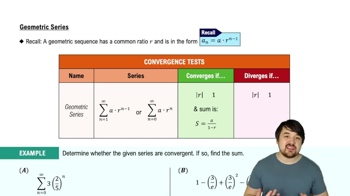
Geometric Series