Ch. 10 - Infinite Sequences and Series
Hass - Thomas' Calculus 15th Edition
Hass15th EditionThomas' CalculusISBN: 9780137616077Non è quello che usi tu?Cambia libro di testo
Capitolo 10, Problema 10.1.2

Finding Terms of a Sequence
Each of Exercises 1–6 gives a formula for the nth term aₙ of a sequence {aₙ}. Find the values of a₁, a₂, a₃, and a₄.
aₙ = 1 / n!

Guida verificata passo dopo passo
1
Understand the given formula for the nth term of the sequence: \(a_{n} = \frac{1}{n!}\), where \(n!\) (n factorial) is the product of all positive integers from 1 to \(n\).
Calculate \(a_1\) by substituting \(n=1\) into the formula: \(a_1 = \frac{1}{1!}\).
Calculate \(a_2\) by substituting \(n=2\) into the formula: \(a_2 = \frac{1}{2!}\).
Calculate \(a_3\) by substituting \(n=3\) into the formula: \(a_3 = \frac{1}{3!}\).
Calculate \(a_4\) by substituting \(n=4\) into the formula: \(a_4 = \frac{1}{4!}\).

Risposta video verificata per un problema simile:

Questa soluzione video è stata consigliata dai nostri tutor come utile per risolvere questo problema.
Durata del video:
2m

Concetti chiave

Ecco i concetti essenziali che devi comprendere per rispondere correttamente alla domanda.

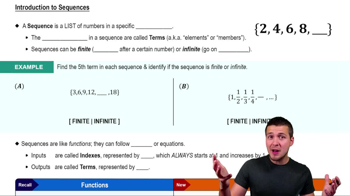
Sequences and Terms

A sequence is an ordered list of numbers defined by a specific rule or formula for its terms. Each term is identified by its position n, and the nth term aₙ gives the value at that position. Understanding how to interpret and use the formula for aₙ is essential to find specific terms.
Video consigliato:
8:22
Introduction to Sequences

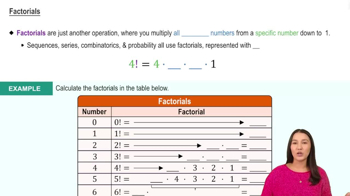
Factorial Function (n!)

The factorial of a positive integer n, denoted n!, is the product of all positive integers from 1 to n. For example, 4! = 4 × 3 × 2 × 1 = 24. By definition, 0! = 1. Factorials grow rapidly and are commonly used in sequences and series.
Video consigliato:
5:22
Factorials

Evaluating Terms of a Sequence

To find specific terms like a₁, a₂, a₃, and a₄, substitute the term number n into the given formula. For aₙ = 1/n!, calculate the factorial of n and then take its reciprocal. This process allows you to generate the first few terms of the sequence explicitly.
Video consigliato:
8:22
Introduction to Sequences