Ch. 10 - Infinite Sequences and Series
Hass - Thomas' Calculus 15th Edition
Hass15th EditionThomas' CalculusISBN: 9780137616077Non è quello che usi tu?Cambia libro di testo
Capitolo 10, Problema 10.7.10

Intervals of Convergence
In Exercises 1–36, (a) find the series’ radius and interval of convergence. For what values of x does the series converge (b) absolutely, (c) conditionally?
∑ (from n = 1 to ∞) [ (x − 1)ⁿ / √n ]

Guida verificata passo dopo passo
1
Identify the given power series: \(\sum_{n=1}^{\infty} \frac{(x - 1)^n}{\sqrt{n}}\) and recognize that it is centered at \(x = 1\).
To find the radius of convergence, apply the Root Test or Ratio Test. Here, the Root Test is convenient: consider \(\lim_{n \to \infty} \sqrt[n]{\left| \frac{(x - 1)^n}{\sqrt{n}} \right|} = \lim_{n \to \infty} \frac{|x - 1|}{n^{1/(2n)}}\).
Since \(\lim_{n \to \infty} n^{1/(2n)} = 1\), the limit simplifies to \(|x - 1|\). For convergence, this limit must be less than 1, so the radius of convergence is \(R = 1\) and the interval of convergence is initially \(1 - 1 < x < 1 + 1\), or \((0, 2)\).
Next, check convergence at the endpoints \(x = 0\) and \(x = 2\) by substituting into the series: at \(x=0\), the series becomes \(\sum_{n=1}^{\infty} \frac{(-1)^n}{\sqrt{n}}\); at \(x=2\), it becomes \(\sum_{n=1}^{\infty} \frac{1}{\sqrt{n}}\). Analyze these using the Alternating Series Test and p-series test respectively.
Determine absolute convergence by testing \(\sum_{n=1}^{\infty} \left| \frac{(x - 1)^n}{\sqrt{n}} \right| = \sum_{n=1}^{\infty} \frac{|x - 1|^n}{\sqrt{n}}\). This series converges absolutely when \(|x - 1| < 1\). For conditional convergence, check if the series converges at endpoints where absolute convergence fails.

Risposta video verificata per un problema simile:

Questa soluzione video è stata consigliata dai nostri tutor come utile per risolvere questo problema.
Durata del video:
16m

Concetti chiave

Ecco i concetti essenziali che devi comprendere per rispondere correttamente alla domanda.

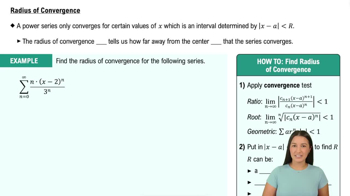
Radius and Interval of Convergence

The radius of convergence is the distance from the center of a power series within which the series converges. The interval of convergence includes all x-values for which the series converges, possibly including endpoints. It is found using tests like the Ratio or Root Test applied to the general term.
Video consigliato:
07:36
Radius of Convergence

Absolute Convergence

A series converges absolutely if the series of absolute values converges. This means ∑|a_n| converges, which guarantees convergence regardless of term signs. Absolute convergence implies regular convergence and is often easier to test using comparison or root tests.
Video consigliato:
Percorso guidato
07:51
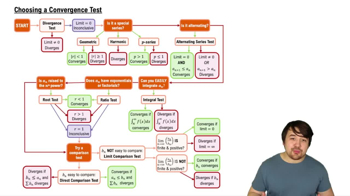
Choosing a Convergence Test

Conditional Convergence

Conditional convergence occurs when a series converges, but does not converge absolutely. This means the series ∑a_n converges, but ∑|a_n| diverges. It often happens at the endpoints of the interval of convergence and requires tests like the Alternating Series Test.
Video consigliato:
Percorso guidato
07:51
Choosing a Convergence Test