
Ch. 10 - Infinite Sequences and Series
Hass - Thomas' Calculus 15th Edition
Hass15th EditionThomas' CalculusISBN: 9780137616077Non è quello che usi tu?Cambia libro di testo
Capitolo 10, Problema 10.2.59

Which series in Exercises 53–76 converge, and which diverge? Give reasons for your answers. If a series converges, find its sum.
∑ (from n = 0 to ∞) e^(−2n)

Guida verificata passo dopo passo
1
Identify the type of series given: \( \sum_{n=0}^{\infty} e^{-2n} \). Notice that this is a geometric series because each term can be written as \( (e^{-2})^n \).
Recall the formula for the sum of an infinite geometric series: if \( |r| < 1 \), then \( \sum_{n=0}^{\infty} ar^n = \frac{a}{1-r} \), where \( a \) is the first term and \( r \) is the common ratio.
Determine the first term \( a \) and the common ratio \( r \) for this series. Here, \( a = e^{-2 \cdot 0} = 1 \) and \( r = e^{-2} \).
Check the convergence condition by verifying if \( |r| < 1 \). Since \( e^{-2} \) is a positive number less than 1, the series converges.
Use the sum formula to express the sum of the series as \( \frac{1}{1 - e^{-2}} \). This represents the sum of the infinite series.

Risposta video verificata per un problema simile:

Questa soluzione video è stata consigliata dai nostri tutor come utile per risolvere questo problema.
Durata del video:
1m

Concetti chiave

Ecco i concetti essenziali che devi comprendere per rispondere correttamente alla domanda.

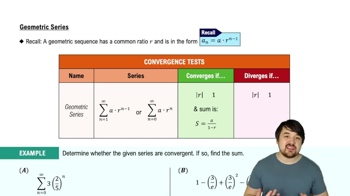
Geometric Series

A geometric series is a series where each term is obtained by multiplying the previous term by a constant ratio r. It converges if the absolute value of r is less than 1, and its sum can be found using the formula S = a / (1 - r), where a is the first term.
Video consigliato:
Percorso guidato
06:00
Geometric Series

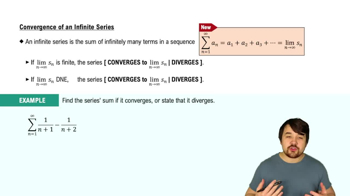
Convergence Criteria for Infinite Series

An infinite series converges if the sequence of its partial sums approaches a finite limit. For geometric series, this depends on the common ratio, while for other series, tests like the comparison or ratio test may be used to determine convergence or divergence.
Video consigliato:
Percorso guidato
06:52
Convergence of an Infinite Series

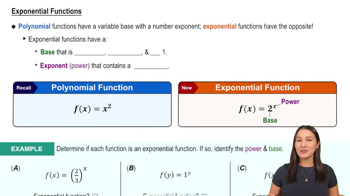
Exponential Functions in Series

Exponential functions of the form e^(−kn) decrease rapidly as n increases when k > 0. When used as terms in a series, they often form geometric series with ratio e^(−k), which helps in analyzing convergence and calculating sums.
Video consigliato:
6:13
Exponential Functions