Ch. 10 - Infinite Sequences and Series
Hass - Thomas' Calculus 15th Edition
Hass15th EditionThomas' CalculusISBN: 9780137616077Non è quello che usi tu?Cambia libro di testo
Capitolo 10, Problema 10.PE.55

Power Series
In Exercises 47–56, (a) find the series’ radius and interval of convergence. Then identify the values of x for which the series converges (b) absolutely and (c) conditionally.
∑ (from n = 1 to ∞) (csch n)xⁿ

Guida verificata passo dopo passo
1
Identify the given power series: \( \sum_{n=1}^{\infty} \text{csch}(n) x^n \), where \( \text{csch}(n) = \frac{1}{\sinh(n)} \).
To find the radius of convergence, use the Root Test or Ratio Test. Here, the Root Test is convenient: compute \( \lim_{n \to \infty} \sqrt[n]{|\text{csch}(n) x^n|} = \lim_{n \to \infty} |x| \sqrt[n]{|\text{csch}(n)|} \).
Analyze the behavior of \( \text{csch}(n) \) as \( n \to \infty \). Since \( \sinh(n) \) grows exponentially, \( \text{csch}(n) \) tends to zero exponentially, so \( \sqrt[n]{|\text{csch}(n)|} \) tends to a limit less than 1.
Use this limit to find the radius of convergence \( R \) by solving \( \lim_{n \to \infty} \sqrt[n]{|\text{csch}(n)|} \cdot |x| < 1 \), which simplifies to \( |x| < R \).
For the interval of convergence, check the endpoints \( x = \pm R \) by substituting into the series and testing for convergence using appropriate tests (e.g., Alternating Series Test or Comparison Test). Then determine where the series converges absolutely (when \( \sum |\text{csch}(n) x^n| \) converges) and conditionally (when the original series converges but not absolutely).

Risposta video verificata per un problema simile:

Questa soluzione video è stata consigliata dai nostri tutor come utile per risolvere questo problema.
Durata del video:
16m

Concetti chiave

Ecco i concetti essenziali che devi comprendere per rispondere correttamente alla domanda.

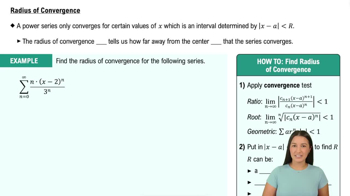
Power Series and Radius of Convergence

A power series is an infinite sum of terms in the form a_n(x - c)^n, where a_n are coefficients and c is the center. The radius of convergence is the distance from c within which the series converges. It can be found using tests like the Ratio or Root Test, determining where the series behaves well.
Video consigliato:
07:36
Radius of Convergence

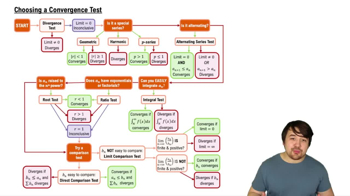
Absolute and Conditional Convergence

A series converges absolutely if the series of absolute values converges, ensuring strong convergence regardless of term signs. Conditional convergence occurs when the original series converges but the absolute value series diverges, often involving alternating or sign-changing terms.
Video consigliato:
Percorso guidato
07:51
Choosing a Convergence Test

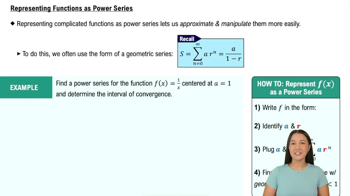
Hyperbolic Cosecant Function (csch n) in Series Terms

The hyperbolic cosecant, csch n, is defined as 1/sinh n and decreases exponentially as n increases. Understanding its behavior helps analyze the coefficients' size in the series, which affects convergence tests and the radius of convergence for the power series.
Video consigliato:
07:32
Representing Functions as Power Series