
Ch. 11 - Parametric Equations and Polar Coordinates
Hass - Thomas' Calculus 15th Edition
Hass15th EditionThomas' CalculusISBN: 9780137616077Non è quello che usi tu?Cambia libro di testo
Capitolo 11, Problema 11.5.18

Finding Polar Areas


Find the areas of the regions in Exercises 9–18.


Inside the circle r = 4 sin θ and below the horizontal line r = 3 csc θ

Guida verificata passo dopo passo
1
First, identify the curves given in polar coordinates: the circle is described by \(r = 4 \sin \theta\) and the line by \(r = 3 \csc \theta\). Understand that \(\csc \theta = \frac{1}{\sin \theta}\), so the line can be rewritten as \(r = \frac{3}{\sin \theta}\).
Next, determine the region of interest: the area inside the circle \(r = 4 \sin \theta\) and below the line \(r = 3 \csc \theta\). This means we want the set of points where \(r\) is less than or equal to \(4 \sin \theta\) and also less than or equal to \(3 \csc \theta\), with \(r\) values corresponding to points below the line.
Find the points of intersection between the two curves by setting \(4 \sin \theta = 3 \csc \theta\). Rewrite \(\csc \theta\) as \(\frac{1}{\sin \theta}\) to get \(4 \sin \theta = \frac{3}{\sin \theta}\). Multiply both sides by \(\sin \theta\) to obtain \(4 \sin^2 \theta = 3\). Solve for \(\sin \theta\) to find the values of \(\theta\) where the curves intersect.
Determine the limits of integration for \(\theta\) based on the intersection points and the region described (inside the circle and below the line). These limits will define the angular bounds for the area integral.
Set up the integral for the area in polar coordinates using the formula \(A = \frac{1}{2} \int_{\alpha}^{\beta} r^2 \, d\theta\). Since the region is bounded by two curves, express the area as the integral of the difference of the squares of the radii: \(A = \frac{1}{2} \int_{\alpha}^{\beta} \left( (4 \sin \theta)^2 - (3 \csc \theta)^2 \right) d\theta\). This integral will give the area of the region inside the circle and below the line.

Risposta video verificata per un problema simile:

Questa soluzione video è stata consigliata dai nostri tutor come utile per risolvere questo problema.
Durata del video:
10m

Concetti chiave

Ecco i concetti essenziali che devi comprendere per rispondere correttamente alla domanda.

Polar Coordinates and Graphing

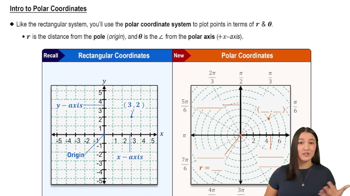
Polar coordinates represent points using a radius and an angle (r, θ) instead of Cartesian coordinates. Understanding how to graph polar equations like r = 4 sin θ and r = 3 csc θ is essential to visualize the regions whose areas are to be found.
Video consigliato:
05:32
Intro to Polar Coordinates

Area Calculation in Polar Coordinates

The area enclosed by a polar curve r(θ) between angles α and β is found using the integral (1/2) ∫ from α to β of [r(θ)]² dθ. This formula is fundamental for computing areas bounded by one or more polar curves.
Video consigliato:
05:32
Intro to Polar Coordinates

Determining Intersection Points and Limits of Integration

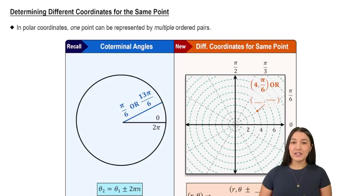
To find the area of the region inside one curve and below another, it is crucial to find their points of intersection by solving r-values and corresponding θ. These intersection points define the limits of integration for the area calculation.
Video consigliato:
6:02
Determining Different Coordinates for the Same Point
Pratica correlata