
Ch. 11 - Parametric Equations and Polar Coordinates
Hass - Thomas' Calculus 15th Edition
Hass15th EditionThomas' CalculusISBN: 9780137616077Non è quello che usi tu?Cambia libro di testo
Capitolo 11, Problema 11.2.18

Implicitly Defined Parametrizations


Assuming that the equations in Exercises 15−20 define x and y implicitly as differentiable functions x=f(t), y=g(t), find the slope of the curve x=f(t), y=g(t) at the given value of t.


x sin t + 2x = t, t sin t − 2t = y, t = π

Guida verificata passo dopo passo
1
Identify the given implicit equations: \(x \sin t + 2x = t\) and \(t \sin t - 2t = y\), where \(x\) and \(y\) are functions of \(t\).
Differentiate both equations with respect to \(t\) using implicit differentiation. For the first equation, apply the product rule to \(x \sin t\) and remember that \(x\) is a function of \(t\): \(\frac{d}{dt}(x \sin t) + \frac{d}{dt}(2x) = \frac{d}{dt}(t)\)
Express the derivatives explicitly: \(\frac{dx}{dt} \sin t + x \cos t + 2 \frac{dx}{dt} = 1\)
Solve this equation for \(\frac{dx}{dt}\), which represents \(x'(t)\), the derivative of \(x\) with respect to \(t\).
For the second equation, differentiate \(y = t \sin t - 2t\) with respect to \(t\) to find \(\frac{dy}{dt}\), then find the slope of the curve at \(t = \pi\) by calculating \(\frac{dy/dt}{dx/dt}\).

Risposta video verificata per un problema simile:

Questa soluzione video è stata consigliata dai nostri tutor come utile per risolvere questo problema.
Durata del video:
6m

Concetti chiave

Ecco i concetti essenziali che devi comprendere per rispondere correttamente alla domanda.

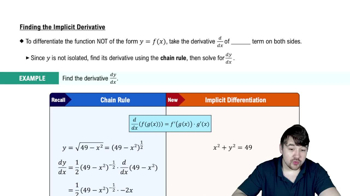
Implicit Differentiation

Implicit differentiation is a technique used to find derivatives of functions defined implicitly by equations involving both variables. Instead of solving explicitly for one variable, we differentiate both sides with respect to the independent variable, applying the chain rule to terms involving dependent variables.
Video consigliato:
Percorso guidato
05:14
Finding The Implicit Derivative

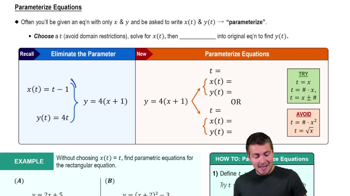
Parametric Equations and Derivatives

Parametric equations express coordinates as functions of a parameter, often t. The slope of the curve at a point is found by computing dy/dx = (dy/dt) / (dx/dt), which requires differentiating both x(t) and y(t) with respect to t and then dividing the results.
Video consigliato:
08:02
Parameterizing Equations

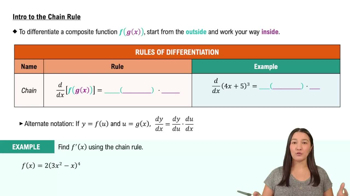
Chain Rule in Differentiation

The chain rule allows differentiation of composite functions by multiplying the derivative of the outer function by the derivative of the inner function. It is essential when differentiating implicit functions or parametric forms where variables depend on a parameter.
Video consigliato:
05:02
Intro to the Chain Rule
Pratica correlata
Domanda del libro di testo

Finding Cartesian from Parametric Equations


Exercises 1–18 give parametric equations and parameter intervals for the motion of a particle in the xy-plane. Identify the particle’s path by finding a Cartesian equation for it. Graph the Cartesian equation. (The graphs will vary with the equation used.) Indicate the portion of the graph traced by the particle and the direction of motion.


x = 1 + sin t, y = cos t − 2, 0 ≤ t ≤ π

32
views
Domanda del libro di testo

Symmetries and Polar Graphs


Identify the symmetries of the curves in Exercises 1–12. Then sketch the curves in the xy-plane.


r = 1 + 2 sin θ

32
views
Domanda del libro di testo

Finding Polar Areas


Find the areas of the regions in Exercises 9–18.


Inside the circle r = 4 sin θ and below the horizontal line r = 3 csc θ

18
views
Domanda del libro di testo

Theory and Examples


Tangents Find equations for the tangents to the circle (x − 2)² + (y − 1)² = 5 at the points where the circle crosses the coordinate axes.

37
views
Domanda del libro di testo

Shifting Conic Sections


Find the center, foci, vertices, asymptotes, and radius, as appropriate, of the conic sections in Exercises 57-68.


9x² + 6y² + 36y = 0

24
views
Domanda del libro di testo

Finding Cartesian from Parametric Equations


Exercises 1–18 give parametric equations and parameter intervals for the motion of a particle in the xy-plane. Identify the particle’s path by finding a Cartesian equation for it. Graph the Cartesian equation. (The graphs will vary with the equation used.) Indicate the portion of the graph traced by the particle and the direction of motion.


x = 2 sinh t, y = 2 cosh t, −∞<t<∞

28
views