Ch. 2 - Limits and Continuity
Hass - Thomas' Calculus 15th Edition
Hass15th EditionThomas' CalculusISBN: 9780137616077Non è quello che usi tu?Cambia libro di testo
Capitolo 2, Problema 2.5.29

At what points are the functions in Exercises 13–30 continuous?


g(x) = { (x² − x – 6)/(x – 3), x ≠ 3
5, x = 3

Guida verificata passo dopo passo
1
Identify the type of function given: The function g(x) is a piecewise function with two parts. The first part is a rational function (x² − x − 6)/(x − 3) for x ≠ 3, and the second part is a constant function g(x) = 5 for x = 3.
Determine the continuity of the rational function: A rational function is continuous everywhere in its domain. However, the domain of (x² − x − 6)/(x − 3) excludes x = 3 because it would make the denominator zero.
Simplify the rational function: Factor the numerator x² − x − 6 to see if the discontinuity at x = 3 can be removed. The numerator factors as (x − 3)(x + 2). Thus, the function simplifies to (x + 2) when x ≠ 3.
Check the limit as x approaches 3: Calculate the limit of the simplified function (x + 2) as x approaches 3. This limit is 5, which matches the value of the function at x = 3.
Conclude the continuity: Since the limit of g(x) as x approaches 3 equals the value of g(x) at x = 3, the function is continuous at x = 3. Therefore, g(x) is continuous for all real numbers.

Risposta video verificata per un problema simile:

Questa soluzione video è stata consigliata dai nostri tutor come utile per risolvere questo problema.
Durata del video:
3m

Concetti chiave

Ecco i concetti essenziali che devi comprendere per rispondere correttamente alla domanda.

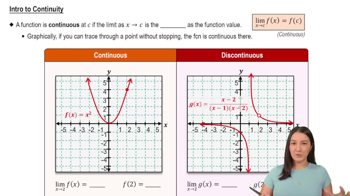
Continuity of Functions

A function is continuous at a point if the limit of the function as it approaches that point equals the function's value at that point. This means there are no breaks, jumps, or holes in the graph of the function at that point. For a function to be continuous everywhere, it must be continuous at every point in its domain.
Video consigliato:
05:34
Intro to Continuity

Limits

The limit of a function describes the behavior of the function as it approaches a specific input value. It is essential for determining continuity, as a function can be continuous only if the limit exists and equals the function's value at that point. In this case, we need to evaluate the limit of g(x) as x approaches 3 to check for continuity.
Video consigliato:
05:50
One-Sided Limits

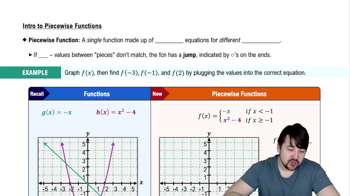
Piecewise Functions

A piecewise function is defined by different expressions based on the input value. In this case, g(x) has two definitions: one for x ≠ 3 and another for x = 3. Understanding how to analyze each piece separately is crucial for determining the overall continuity of the function at the specified points.
Video consigliato:
Percorso guidato
05:36
Piecewise Functions