Ch. 2 - Limits and Continuity
Hass - Thomas' Calculus 15th Edition
Hass15th EditionThomas' CalculusISBN: 9780137616077Non è quello che usi tu?Cambia libro di testo
Capitolo 2, Problema 2.6.69

Domains and Asymptotes


Determine the domain of each function in Exercises 69–72. Then use various limits to find the asymptotes.


y = 4 + 3x² / (x² + 1)

Guida verificata passo dopo passo
1
Step 1: Identify the domain of the function. The function given is \( y = 4 + \frac{3x^2}{x^2 + 1} \). Since the denominator \( x^2 + 1 \) is always positive and never zero for all real numbers, the domain of the function is all real numbers, \( (-\infty, \infty) \).
Step 2: Determine the horizontal asymptote by evaluating the limit of the function as \( x \to \infty \) and \( x \to -\infty \). For large values of \( x \), the term \( \frac{3x^2}{x^2 + 1} \) approaches \( \frac{3x^2}{x^2} = 3 \). Therefore, the horizontal asymptote is \( y = 4 + 3 = 7 \).
Step 3: Check for vertical asymptotes by finding values of \( x \) that make the denominator zero. Since \( x^2 + 1 \) is never zero for real \( x \), there are no vertical asymptotes.
Step 4: Consider the behavior of the function as \( x \to 0 \). Substitute \( x = 0 \) into the function to find \( y = 4 + \frac{3(0)^2}{0^2 + 1} = 4 \). This confirms that there is no vertical asymptote at \( x = 0 \).
Step 5: Summarize the findings. The domain of the function is all real numbers, \( (-\infty, \infty) \). The function has a horizontal asymptote at \( y = 7 \) and no vertical asymptotes.

Risposta video verificata per un problema simile:

Questa soluzione video è stata consigliata dai nostri tutor come utile per risolvere questo problema.
Durata del video:
3m

Concetti chiave

Ecco i concetti essenziali che devi comprendere per rispondere correttamente alla domanda.

Domain of a Function

The domain of a function refers to the set of all possible input values (x-values) for which the function is defined. For rational functions, the domain is typically restricted by values that make the denominator zero, as these would lead to undefined outputs. In the given function, identifying the domain involves analyzing the expression to determine any restrictions on x.
Video consigliato:
Percorso guidato
5:10
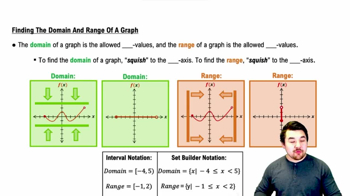
Finding the Domain and Range of a Graph

Limits

Limits are a fundamental concept in calculus that describe the behavior of a function as the input approaches a certain value. They are essential for understanding continuity, derivatives, and asymptotic behavior. In the context of finding asymptotes, limits help determine the values that the function approaches as x approaches infinity or any critical points where the function may not be defined.
Video consigliato:
05:50
One-Sided Limits

Asymptotes

Asymptotes are lines that a graph approaches but never touches or crosses. There are three types: vertical asymptotes, which occur where the function is undefined (often due to division by zero); horizontal asymptotes, which describe the behavior of the function as x approaches infinity; and oblique asymptotes, which occur in certain rational functions. Identifying asymptotes involves using limits to analyze the function's behavior at critical points.
Video consigliato:
Percorso guidato
5:37
Introduction to Cotangent Graph