Ch. 2 - Limits and Continuity
Hass - Thomas' Calculus 15th Edition
Hass15th EditionThomas' CalculusISBN: 9780137616077Non è quello che usi tu?Cambia libro di testo
Capitolo 2, Problema 2.1.2a

Average Rates of Change


In Exercises 1–6, find the average rate of change of the function over the given interval or intervals.


g(x)=x²−2x


a. [1, 3]

Guida verificata passo dopo passo
1
Identify the function given: \( g(x) = x^2 - 2x \).
Recall the formula for the average rate of change of a function \( g(x) \) over an interval \([a, b]\): \( \frac{g(b) - g(a)}{b - a} \).
Substitute the interval \([1, 3]\) into the formula, where \( a = 1 \) and \( b = 3 \).
Calculate \( g(1) \) by substituting \( x = 1 \) into the function: \( g(1) = 1^2 - 2 \times 1 \).
Calculate \( g(3) \) by substituting \( x = 3 \) into the function: \( g(3) = 3^2 - 2 \times 3 \).

Risposta video verificata per un problema simile:

Questa soluzione video è stata consigliata dai nostri tutor come utile per risolvere questo problema.
Durata del video:
2m

Concetti chiave

Ecco i concetti essenziali che devi comprendere per rispondere correttamente alla domanda.

Average Rate of Change

The average rate of change of a function over an interval [a, b] is defined as the change in the function's value divided by the change in the input value. Mathematically, it is expressed as (f(b) - f(a)) / (b - a). This concept is crucial for understanding how a function behaves over a specific range and is often used to analyze the function's growth or decline.
Video consigliato:
Percorso guidato
06:37
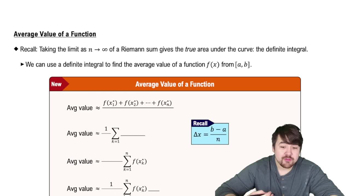
Average Value of a Function

Function Evaluation

Function evaluation involves substituting a specific value into a function to determine its output. For the function g(x) = x² - 2x, evaluating it at points 1 and 3 means calculating g(1) and g(3). This step is essential for finding the values needed to compute the average rate of change over the specified interval.
Video consigliato:
Percorso guidato
4:26
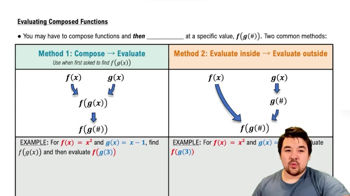
Evaluating Composed Functions

Quadratic Functions

Quadratic functions are polynomial functions of degree two, typically expressed in the form f(x) = ax² + bx + c. The function g(x) = x² - 2x is a quadratic function where a = 1, b = -2, and c = 0. Understanding the properties of quadratic functions, such as their parabolas' shape and vertex, is important for analyzing their behavior over intervals.
Video consigliato:
6:04
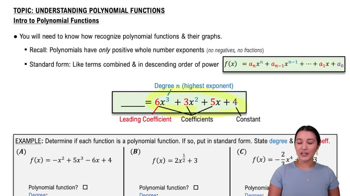
Introduction to Polynomial Functions