Ch. 2 - Limits and Continuity
Hass - Thomas' Calculus 15th Edition
Hass15th EditionThomas' CalculusISBN: 9780137616077Non è quello che usi tu?Cambia libro di testo
Capitolo 2, Problema 2.29a

[Technology Exercise] Roots


Let ƒ(𝓍) = 𝓍³ ―𝓍― 1.


a. Use the Intermediate Value Theorem to show that ƒ has a zero between ―1 and 2 .

Guida verificata passo dopo passo
1
First, understand the Intermediate Value Theorem (IVT): It states that if a function f is continuous on a closed interval [a, b] and N is any number between f(a) and f(b), then there exists at least one c in the interval (a, b) such that f(c) = N.
Check the continuity of the function f(𝓍) = 𝓍³ - 𝓍 - 1. Since this is a polynomial function, it is continuous everywhere, including on the interval [-1, 2].
Evaluate the function at the endpoints of the interval: Calculate f(-1) and f(2).
Calculate f(-1): Substitute 𝓍 = -1 into the function: f(-1) = (-1)³ - (-1) - 1. Simplify this expression to find the value of f(-1).
Calculate f(2): Substitute 𝓍 = 2 into the function: f(2) = (2)³ - (2) - 1. Simplify this expression to find the value of f(2).

Risposta video verificata per un problema simile:

Questa soluzione video è stata consigliata dai nostri tutor come utile per risolvere questo problema.
Durata del video:
4m

Concetti chiave

Ecco i concetti essenziali che devi comprendere per rispondere correttamente alla domanda.

Intermediate Value Theorem

The Intermediate Value Theorem states that if a function is continuous on a closed interval [a, b] and takes on different signs at the endpoints, then there exists at least one c in (a, b) such that f(c) = 0. This theorem is crucial for proving the existence of roots within a specified interval.
Video consigliato:
Percorso guidato
06:11
Fundamental Theorem of Calculus Part 1

Continuity of Functions

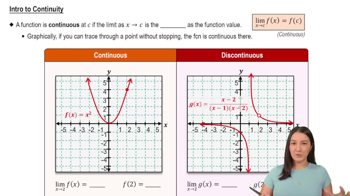
A function is continuous if there are no breaks, jumps, or holes in its graph. For the Intermediate Value Theorem to apply, the function must be continuous over the interval in question. Polynomial functions, like ƒ(𝓍) = 𝓍³ - 𝓍 - 1, are continuous everywhere, making them suitable for this theorem.
Video consigliato:
05:34
Intro to Continuity

Evaluating Function Values

To apply the Intermediate Value Theorem, we need to evaluate the function at the endpoints of the interval. By calculating ƒ(-1) and ƒ(2), we can determine the signs of these values. If they are of opposite signs, it confirms the existence of at least one root in the interval (-1, 2).
Video consigliato:
Percorso guidato
06:37
Average Value of a Function