Ch. 2 - Limits and Continuity
Hass - Thomas' Calculus 15th Edition
Hass15th EditionThomas' CalculusISBN: 9780137616077Non è quello che usi tu?Cambia libro di testo
Capitolo 2, Problema 2.5.40

Find the limits in Exercises 31–40. Are the functions continuous at the point being approached?
lim ϴ → 0 cos (πϴ/sin ϴ)

Guida verificata passo dopo passo
1
First, recognize that the limit involves a trigonometric function as ϴ approaches 0. The expression is cos(πϴ/sinϴ).
To evaluate the limit, consider the behavior of the argument of the cosine function, πϴ/sinϴ, as ϴ approaches 0.
Use the trigonometric identity sinϴ ≈ ϴ when ϴ is near 0. This approximation helps simplify the expression πϴ/sinϴ to π, since sinϴ/ϴ approaches 1.
Substitute the simplified argument back into the cosine function: cos(πϴ/sinϴ) becomes cos(π) as ϴ approaches 0.
Evaluate cos(π) to determine the limit. Then, consider the definition of continuity: a function is continuous at a point if the limit as ϴ approaches that point equals the function's value at that point. Check if this condition holds for the given function at ϴ = 0.

Risposta video verificata per un problema simile:

Questa soluzione video è stata consigliata dai nostri tutor come utile per risolvere questo problema.
Durata del video:
4m

Concetti chiave

Ecco i concetti essenziali che devi comprendere per rispondere correttamente alla domanda.

Limits

A limit is a fundamental concept in calculus that describes the behavior of a function as its input approaches a certain value. It helps in understanding how functions behave near points of interest, including points of discontinuity. In this case, we are interested in the limit of the function as θ approaches 0, which requires evaluating the function's behavior close to that point.
Video consigliato:
05:50
One-Sided Limits

Continuity

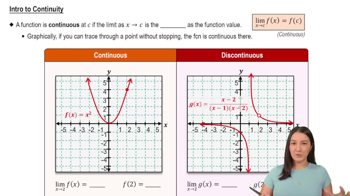
A function is continuous at a point if the limit of the function as it approaches that point equals the function's value at that point. For the given limit, we need to determine if the function cos(πθ/sin(θ)) is continuous at θ = 0. This involves checking if the limit exists and matches the function's value at that point.
Video consigliato:
05:34
Intro to Continuity

Trigonometric Limits

Trigonometric limits often involve special techniques or identities to evaluate limits involving sine and cosine functions. In this case, the limit involves the sine function in the denominator, which approaches 0 as θ approaches 0. Understanding how to manipulate trigonometric expressions and apply L'Hôpital's Rule or Taylor series can be crucial for finding the limit accurately.
Video consigliato:
Percorso guidato
6:04
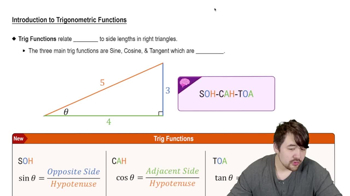
Introduction to Trigonometric Functions
Pratica correlata
Domanda del libro di testo

Finding One-Sided Limits Algebraically


Find the limits in Exercises 11–20.


limx→1− (1/(x + 1))((x + 6)/x)((3 − x)/7)

219
views

Domanda del libro di testo

Using the Sandwich Theorem


a. It can be shown that the inequalities 1 − x²/ 6 < (x sin x) / (2−2cos x) < 1 hold for all values of x close to zero (except for x = 0). What, if anything, does this tell you about limx→0 (x sin x) / (2 − 2cos x)?


Give reasons for your answer.


[Technology Exercise] b. Graph y = 1 − (x²/6), y=(x sinx)/(2 − 2cos x), and y = 1 together for −2 ≤ x ≤2. Comment on the behavior of the graphs as x→0.

359
views
Domanda del libro di testo

Use the Intermediate Value Theorem in Exercises 69–74 to prove that each equation has a solution. Then use a graphing calculator or computer grapher to solve the equations.

x³ − 15x + 1 = 0 (three roots)

338
views
Domanda del libro di testo

Theory and Examples


If limx→4 (f(x) − 5) / (x − 2) = 1, find limx→4 f(x).

259
views
Domanda del libro di testo

Finding Limits of Differences When x → ±∞


Find the limits in Exercises 84–90. (Hint: Try multiplying and dividing by the conjugate.)


lim x → ∞ (√(x² + 25) − √(x² − 1))

196
views
Domanda del libro di testo

Limits as x → ∞ or x → −∞


The process by which we determine limits of rational functions applies equally well to ratios containing noninteger or negative powers of x. Divide numerator and denominator by the highest power of x in the denominator and proceed from there. Find the limits in Exercises 23–36. Write ∞ or −∞ where appropriate.


lim x→∞ (2√x + x⁻¹) / (3x − 7)

296
views